Age of Sail — Chronological Timeline
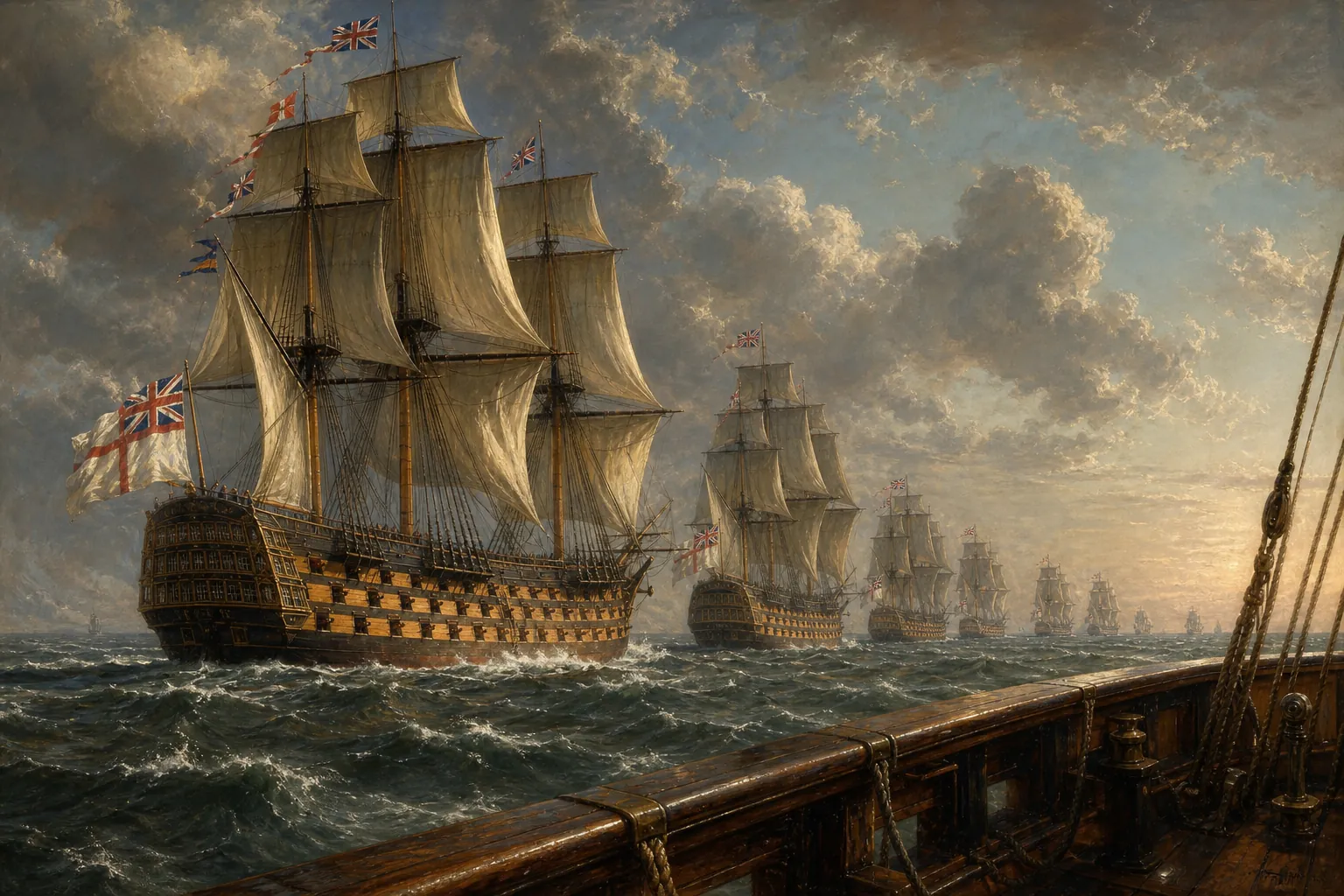 Generated illustration. Not a historical photograph. A fleet of ships of the line in line-ahead.
This page is a chronology of dated facts already in the vault. It invents nothing. Each line wiki-links the note that already holds the source. Undated careers, later British prize-names, and empty-room subjects stay on RESEARCH_QUEUE.
The era frame on Age of Sail — Era Overview is approximately 1650–1815. The era opens approximately with the Anglo-Dutch Wars — Era Opening 1652–1674. Same era overview. No battle list is filled. The filled notes below are the Nelson wars, 1796–1805, plus the two first-rate launch years already on the class note and the later Hardy dates already on his note.
1748–1786
-
1716 — George Collingwood, great-grandfather of Collingwood Cuthbert — Biography, is hanged at Liverpool for Jacobite involvement in the Fifteen. George Collingwood — Hanged at Liverpool 1716. Same Collingwood note. No Jacobite campaign is filled.
-
26 September 1748 — Collingwood Cuthbert — Biography born in Newcastle upon Tyne. Newcastle upon Tyne — Collingwood Birthplace. Same Collingwood note. Royal Grammar School Newcastle is the schooling note; no school year is filled.
-
1761 — Collingwood enters the Navy aged twelve aboard HMS Shannon under his cousin Captain Richard Braithwaite. Collingwood Navy Entry — 1761. Same Collingwood note. Shannon stays unrated.
-
June 1775 — Collingwood fights in the naval brigade at Bunker Hill and is made lieutenant. Bunker Hill — Collingwood Naval Brigade June 1775. Same Collingwood note. No day-of-month. No field-works survey.
-
29 September 1758 — Nelson Horatio — Biography Overview born at Burnham Thorpe — Norfolk Village to a Norfolk clergyman. Same Nelson note.
-
31 December 1763 — Villeneuve Pierre-Charles — French Admiral born at Valensole — Provence. Same Villeneuve note.
-
1778 — Villeneuve enters the Royal French Navy as a garde de la marine, aged fifteen. Villeneuve Garde de la Marine — 1778. Same Villeneuve note.
-
1778 — Victory is flagship of Admiral Keppel at Battle of Ushant 1778. Same Victory note. No first name is filled.
-
5 April 1769 — Hardy Thomas Masterman — Captain HMS Victory born at Kingston Russell House — Dorset. Same Hardy note.
-
1771 — Nelson enters the Navy as midshipman, aged 12, through Suckling Maurice — Captain. Same Nelson note.
-
1779 — Nelson is made captain, aged 20 — youngest post-captain in the Navy. Nelson Post-Captain — 1779. Same Nelson note. No 1779 ship is filled.
-
1779–1780 — Collingwood succeeds Nelson as commander of HMS Badger (1779) and as post-captain of HMS Hinchinbrook (1780). Collingwood Succeeds Nelson — 1779–1780. Same Collingwood note. Those ships stay unrated. Moutray stays on RESEARCH_QUEUE.
-
1759 — HMS Victory — Overview laid down at Chatham Dockyard. Designer: Slade Thomas — Naval Architect. Same Victory note; Chatham Dockyard is the yard-build credit.
-
7 May 1765 — Victory launched at Chatham Dockyard. HMS Victory — Overview; Chatham Dockyard.
-
1765 — HMS Victory — Overview launched as a 104-gun first-rate. The class note records the year: First Rate Ship of the Line — Class Overview.
-
1780 — Copper Sheathing — Hull Protection added to Victory in a refit against the teredo worm. Same Victory note.
-
November 1781 — Hardy enters the Navy as captain’s servant aboard the brig HMS Helena — Brig, aged twelve. Same Hardy note.
-
c. 1782–85 — Hardy attends Crewkerne Grammar School while nominally borne on HMS Seaford and HMS Carnatic. Same Hardy note.
-
1782–83 — Villeneuve serves under Suffren in the Indian Ocean. Same Villeneuve note. Marseillois stays unrated.
-
Villeneuve served as ensign aboard Marseillois in de Grasse’s American war fleet. Marseillois — de Grasse American War Fleet. Same Villeneuve note. No year. No rate.
-
1782 — Victory is present at Battle of Cape Spartel 1782. Same Victory note. Presence only. Not a flagship posting.
-
1774 — HMS Royal Sovereign — Overview laid down at Plymouth Dockyard. The American War starved construction. Royal Sovereign Construction — American War Delay. Same Sovereign note.
-
1786 — HMS Royal Sovereign — Overview launched as a 100-gun first-rate. Same class note.
-
4 September 1786 — Royal Sovereign launched at Plymouth Dockyard. Royal Sovereign Construction — American War Delay; HMS Royal Sovereign — Overview; Plymouth Dockyard.
-
1770s — Wilkinson John — Iron Founder develops boring techniques that dramatically improved 32-pounder reliability. Barrels were bored on a horse-powered mill after vertical-mould casting. The Royal Brass Foundry — Woolwich is the foundry named on the same 32-pounder sentence. 32-Pounder Naval Cannon; Horse-Powered Boring Mill — 32-Pounder Barrels.
1794
- Nelson Horatio — Biography Overview is blinded in the right eye by flying debris at Calvi. Nelson — Loss of Eye at Calvi 1794. No day-of-month is filled.
1791
- June 1791 — Collingwood Cuthbert — Biography marries Sarah Blackett, daughter of a three-times mayor of Newcastle. Same Collingwood note.
1793–1796
- November 1793 — Hardy commissioned second lieutenant in HMS Meleager.
- May 1795 — Villeneuve Pierre-Charles — French Admiral is reinstated after the Revolutionary purges. Villeneuve Reinstated — May 1795. Same Villeneuve note.
- 1795 — Hardy in action at Genoa and the Hyères Islands. Same Hardy note.
- August 1796 — Hardy follows Captain George Cockburn into the frigate HMS Minerve — Frigate, the posting that bound him to Nelson Horatio — Biography Overview.
- October 1796 — Spain joins France against Britain under the second Treaty of San Ildefonso 1796. That alliance is the background of the Battle of Cape St Vincent 1797 — Overview.
- November 1796 — Corsica evacuated. Jervis John Earl St Vincent — Biography withdraws the British Mediterranean fleet to the Tagus. Corsica — Evacuated November 1796. Tagus — Jervis Withdrawal 1796. Same treaty and Cape St Vincent notes.
1797
1 February
- Córdova José de — Spanish Admiral sails from Cartagena — Spanish Naval Port to escort a mercury convoy to Cadiz — Spanish Naval Port, then to rendezvous with the French Brest fleet. Treaty of San Ildefonso 1796; Battle of Cape St Vincent 1797 — Overview.
11 February
- Off Cadiz, a topman falls from HMS Minerve — Frigate. Hardy goes away in a boat. Nelson, commodore aboard, refuses to abandon him. The Spanish break off and Hardy is recovered. Hardy Thomas Masterman — Captain HMS Victory. The spoken line lives on the Hardy note and the source card, not here.
14 February — Cape St Vincent
- Jervis John Earl St Vincent — Biography in HMS Victory — Overview leads 15 British ships of the line against 27 Spanish under Córdova José de — Spanish Admiral off Cape St Vincent — Geography. Battle of Cape St Vincent 1797 — Overview.
- Squally weather had separated the Spanish into two divisions. Cape St Vincent Squalls — 14 February 1797. Same Cape St Vincent note. No later gale is filled.
- 11am — Jervis signals to drive between the two Spanish divisions (18 to leeward, 9 to windward). Jervis Signal — Drive Between 11am 1797. Same Cape St Vincent note. No flag colour is filled. The British line tacks through the gap.
- Troubridge Thomas — British Captain in HMS Culloden — 74-gun Third Rate leads the British line.
- Calder Robert — British Admiral is Captain of the Fleet in Victory.
- About 1:30pm — Nelson Horatio — Biography Overview in HMS Captain — 74-gun Third Rate, second from the rear, wears out of the line without waiting for the ships ahead and throws Captain across the bows of Santísima Trinidad — Spanish First Rate and four other ships.
- Collingwood Cuthbert — Biography in HMS Excellent — 74-gun Third Rate relieves Captain and forces the strikings of Salvador del Mundo — Spanish 112-gun First Rate and San Ysidro — Spanish 74-gun Third Rate in succession.
- San Nicolás — Spanish 84-gun Third Rate and San José — Spanish 112-gun First Rate foul. Nelson runs Captain alongside San Nicolás. Berry Edward — British Captain leads through the stern gallery. Nelson then leads the same party across onto San José — Nelson’s Patent Bridge for Boarding First Rates.
- Four prizes taken: San José (112), Salvador del Mundo (112), San Nicolás (84), San Ysidro (74). About 3,000 prisoners. Santísima Trinidad was in the van and was not one of the four. Four Spanish Prizes of Cape St Vincent 1797.
- British: 73 killed, 327 wounded. No ships lost. Spanish: about 261 killed, 342 wounded. Remaining Spanish ships escape to Cadiz.
- Jervis is created Earl of St Vincent. Nelson is promoted Rear-Admiral and made Knight of the Bath, choosing the KB over a baronetcy for the visible star.
May
- Hardy leads the cutting-out of the French brig La Mutine at Tenerife and is promoted master and commander of the prize, HMS Mutine — Captured French Brig. Hardy Thomas Masterman — Captain HMS Victory.
24 July — Tenerife
- Within minutes of Nelson’s boat touching the shore at Santa Cruz de Tenerife — Spanish Port, grapeshot shatters his right humerus. Night Assault on Santa Cruz — 24 July 1797; Grape Shot — Tenerife 24 July 1797; Nelson — Loss of Arm at Tenerife 1797; Sword Raised at Santa Cruz — 24 July 1797.
- 11pm — Eshelby Thomas — Surgeon HMS Theseus amputates the arm above the elbow aboard HMS Theseus — Overview, about thirty minutes after Nelson returns to the ship. Eshelby’s Surgical Log — 24 July 1797. White p. 112 on those notes. He is writing with his left hand within days. Left-Hand Dispatches — Tenerife 1797. Phantom pain later on Nelson’s Phantom Limb — Belief in the Soul.
- Nelson returned to England, was assessed unfit for command, and feared his career was over. Nelson Unfit for Command — After Tenerife 1797. Same Tenerife note. The Nile a year later stays on that battle note.
1798
19 May
- Bonaparte sails from Toulon with 35,000 troops and 13 ships of the line for Egypt. Battle of the Nile 1798 — Overview; Egyptian Expedition 1798–1801; Egypt Expedition — Threat to the India Route 1798.
- Nelson missed the French at Toulon, Malta, and Alexandria on that chase. Malta — Missed 1798. Same Nile and expedition notes. Alexandria stays on those sentences.
- He then returned from a fruitless sweep to Anatolia and found the fleet at Aboukir. Anatolia — Fruitless Sweep 1798. Same Nile note.
1 August — the Nile, Aboukir Bay
- Afternoon: Nelson finds the French fleet anchored in Aboukir Bay — Egypt. Battle of the Nile 1798 — Overview.
- British: thirteen 74s, the 50-gun HMS Leander — 50-gun Fourth Rate, and the brig HMS Mutine — Captured French Brig under Hardy. Flagship HMS Vanguard — Nelson’s Nile Flagship under Berry Edward — British Captain. About 8,000 men.
- French under Brueys d’Aigalliers François-Paul — French Admiral: thirteen ships of the line — L’Orient — French 120-gun Flagship (120, flag), the 80s Franklin — French 80-gun Ship, Tonnant — French 80-gun Ship, and Guillaume Tell — French 80-gun Ship (Villeneuve), plus nine 74s and four frigates. About 10,000 men. Anchored bow-to-stern, north-west to south-east.
- 3pm — Nelson signals the attack, still 8 miles off, choosing dusk in uncharted shoal water. Nile Attack Signal — 3pm 1 August 1798. Same Nile note. No flag colour is filled.
- Foley Thomas — British Captain in HMS Goliath — 74-gun Third Rate sees the French have not run out their inshore guns and leads five British ships between the French line and the shore, doubling the van.
- 6:30pm — action opens.
- Around 8:30pm — langridge from Spartiate — French Ship of the Line strikes Nelson on the forehead aboard Vanguard. He believes himself dying, then returns to the quarterdeck.
- Around 9pm — L’Orient catches fire.
- Around 10pm — L’Orient explodes. Brueys is killed. Firing ceases for about ten minutes. L’Orient Cease-Fire — Ten Minutes 1 August 1798. Same L’Orient and Nile notes. No treasure is filled. Most of her crew are lost.
- HMS Culloden — 74-gun Third Rate under Troubridge runs aground entering the bay and never engages.
- Westcott George — British Captain of HMS Majestic — 74-gun Third Rate is killed.
- British: 218 killed, 677 wounded. No ships lost. French: about 1,700 killed, 1,500 wounded, 3,000 captured. Eleven of thirteen ships of the line captured or destroyed.
2 August
- Dawn: Villeneuve Pierre-Charles — French Admiral in Guillaume Tell cuts cables and escapes with Généreux — French Ship of the Line and the frigates Diane — French Frigate and Justice — French Frigate. Those four are the only French ships named as getting away.
2 October
- Hardy is posted captain into Vanguard and from that day is Nelson’s flag captain. Hardy Thomas Masterman — Captain HMS Victory; HMS Vanguard — Nelson’s Nile Flagship.
6 November
- Nelson is created Baron Nelson of the Nile. The victory is used to assemble the Second Coalition 1798–1802 (Russia, Austria, the Ottoman Empire, Naples). Ottoman Empire — Second Coalition Partner 1798.
1799
- February 1799 — Collingwood reaches rear-admiral. Collingwood Rear-Admiral and Vice-Admiral — 1799–1804. Same Collingwood note.
- August 1799 — Bonaparte slips back to France in the frigate Muiron — French Frigate, leaving the army in Egypt. Battle of the Nile 1798 — Overview; Egyptian Expedition 1798–1801; Egypt Expedition — Threat to the India Route 1798.
1800
- December 1800 — Tsar Paul I of Russia forms the Second League of Armed Neutrality of the North 1800–1801 with Denmark, Sweden, Russia, and Prussia. Neutral shipping rights against Royal Navy stop-and-search; the Baltic timber, hemp, tar, and pitch on which the navy depends are at stake. Baltic Naval Stores — 1800–1801; Denmark — Armed Neutrality Partner 1800–1801; Armed Neutrality — Neutral Shipping Rights. The Pitt and Addington — Baltic Fleet 1801 dispatch is the same league and Copenhagen notes; no dispatch date is filled.
1801
1 April
- Night: Hardy, in HMS St George — 98-gun Second Rate (too deep for the inshore channel), sounds the King’s Deep inshore of the Danish line. King’s Deep Soundings — Copenhagen 1 April 1801.
2 April — Copenhagen
- Dawn: Nelson takes twelve ships into the channel after transferring into HMS Elephant — 74-gun Third Rate under Foley. Foley Captain Elephant — 2 April 1801. Hyde Parker — British Admiral stays distant in HMS London. Battle of Copenhagen 1801 — Overview. Danish defence under Fischer Olfert — Danish Commodore and Crown Prince Frederik — Denmark.
- HMS Agamemnon — Overview, Bellona, and Russell run aground entering the channel. The inshore force falls from twelve to nine. The battle note says the Danes may have moved the buoys. Channel Buoys — Copenhagen 2 April 1801.
- Around 10am — action opens at close range, ship versus blockship, about four hours.
- Around 1pm — Parker, about three miles off, hoists Signal 39 (discontinue). Nelson puts a telescope to his blind right eye and keeps Signal 16 (engage more closely) flying. Stewart William — Lt-Col is the eyewitness named on that note. The spoken line stays on the battle note and the source card, not here. Q — Did Nelson really say “blind eye” at Copenhagen.
- By 2pm — the Danish line is largely silenced. Trekroner Fort — Copenhagen is still firing. Nelson sends a flag of truce ashore. Frederik accepts. Firing dies away.
- British: 254 killed, 689 wounded. Danish: about 700 killed, 900 wounded, 1,700 prisoners; about 12 Danish ships destroyed or captured. One named prize: Holsteen — Danish 60 (60), later HMS Holstein. Same battle note.
- Paul I has been assassinated ten days before the battle. News has not reached either fleet. Do not put a calendar date on that death; the filled notes do not. News of Paul I’s Death — Not Yet Arrived.
9 April
- Danish armistice signed. Tsar Alexander I of Russia withdraws from the league. Sweden follows. The Baltic reopens to British naval stores. Nelson is created Viscount Nelson of the Nile. Parker is recalled and never holds active command again. Hyde Parker Recalled — After Copenhagen 1801. No recall date is filled.
1803–1804
- July 1803 — Bucentaure — Overview launched at Toulon Arsenal — French Naval Construction Centre; completed 1804. Designer: Sané Jacques-Noël — French Naval Architect. Class frame: Téméraire-Class Two-Deckers — French Naval Doctrine.
- 31 July 1803 — Hardy becomes flag captain of HMS Victory — Overview. Hardy Flag-Captain Victory — 31 July 1803. Same Hardy note.
- April 1804 — Collingwood reaches vice-admiral. Collingwood Rear-Admiral and Vice-Admiral — 1799–1804. Same Collingwood note.
- May 1804 — Villeneuve is made vice-admiral. Villeneuve Vice-Admiral — May 1804. Same Villeneuve note. The August Toulon command stays on Toulon Fleet 1804–05.
- August 1804 — Latouche-Tréville Louis-René — French Admiral dies. Napoleon gives the Toulon Fleet 1804–05 to Villeneuve. Villeneuve Pierre-Charles — French Admiral.
1805
29 March
- Villeneuve leaves Toulon with the Toulon Fleet 1804–05, later joins Gravina Federico — Spanish Admiral at Cadiz, and crosses the Atlantic to Martinique to draw Nelson west. Battle of Cape Finisterre 1805; Trafalgar Campaign 1805.
22 July — Finisterre
-
Off Cape Finisterre — Geography, north-west Spain. Same Finisterre note.
-
Morning: Calder (15 of the line, off the Rochefort and Ferrol blockades) and Villeneuve (20 of the line, including Bucentaure) sight each other in fog. Action delayed until late afternoon. Finisterre Fog — 22 July 1805. Calder Robert — British Admiral; Battle of Cape Finisterre 1805.
-
San Rafael — Spanish 80 and Firme — Spanish 74 taken from Gravina’s contingent. Finisterre Prizes — 22 July 1805.
-
Calder breaks off toward night, intending to fight again. Combined casualty totals stay
status/contestedon the battle note.
23–24 July
- Calder does not renew, citing damaged ships, the prizes, and the Ferrol squadron. On the 24th Villeneuve, with a fair wind, also declines and turns south instead of on to Brest. He later puts into Vigo and Coruña, then Cadiz. The invasion sequence ends. Napoleon’s army leaves Boulogne for Germany.
Late August
- The Combined Fleet is in Cadiz. Nelson Horatio — Biography Overview takes command of the Cadiz blockade. Same Trafalgar Campaign 1805. The army that waited at Boulogne is already on Boulogne — 1805 Invasion Camp.
18 October
- Villeneuve learns that Rosily is at Madrid with orders to relieve him. Same Villeneuve and Decrès notes. Rosily stays a stub.
19 October
- Villeneuve sorties from Cadiz under pressure from Napoleon. Villeneuve Sortie — 19 October 1805. Battle of Trafalgar 1805 — Overview.
Night of 20–21 October
- Nelson’s Prayer Before Trafalgar — Text, Context, and Providential Belief is the night-before note. The prayer text stays on that note and the White card (p. 287).
21 October — Trafalgar
- Nelson, 27 of the line in two columns, against Villeneuve’s 33 (18 French, 15 Spanish) off Cape Trafalgar — Geography. Weather column: Nelson in Victory (12). Lee column: Collingwood Cuthbert — Biography in Royal Sovereign (15). Spanish ships include Santísima Trinidad and Gravina’s reported flag Príncipe de Asturias — Spanish First Rate. French include Bucentaure and Redoutable — French 74-gun Ship.
- About 11:45am — Nelson orders the hoist from Victory: England Expects Signal — Trafalgar 1805; Trafalgar Signal Flags — 21 October 1805 (White p. 312). The wording is on that note.
- Around noon — the British columns cut the Combined line. Royal Sovereign is first into action, under flag captain Rotheram Edward — Captain HMS Royal Sovereign. She crosses astern of Santa Ana — Spanish 112-gun First Rate (112). Same Sovereign note.
- About 12:30pm — Victory passes under Bucentaure’s stern and rakes her. Knight names this the most destructive single moment of the battle.
- About 1:15pm — a marksman in Redoutable’s mizzentop shoots Nelson on Victory’s quarterdeck, about 50 feet. The ball enters the left shoulder, passes through the lung, and lodges in the spine. Battle of Trafalgar 1805 — Death of Nelson. A fore-brace splinter tore Hardy’s shoe-buckle on that quarterdeck. Hardy Shoe-Buckle — Trafalgar 21 October 1805. Same Hardy note. The spoken line stays on the Hardy note and the source card, not here. Nelson Decorations — Trafalgar Coat is the wearing already on the Nelson note.
- 4:30pm — Nelson dies in the cockpit. Beatty pp. 48–52 on that note. Hamilton Emma — Biography. Q — Was it Kiss me Hardy or Kismet Hardy. Nelson–Hamilton Affair — Press Sensation. Nelson Personal Life — Propaganda Machine. The battle note already records that the death transformed him from admiral to national saint. Nelson as National Saint — Trafalgar Myth.
- British: 449 killed, 1,241 wounded. No ships lost. Franco-Spanish: about 4,400 killed, 2,500 wounded, 22 ships captured or destroyed. Many prizes are then lost in the storm.
- Villeneuve, reportedly the only senior officer on Bucentaure not wounded, surrenders to a boarding party from HMS Conqueror — Overview. That capture is on the Bucentaure and Villeneuve notes. The Bucentaure note names Capt. James Atcherley as leading the party.
- Victory’s quarterdeck and forecastle at Trafalgar include 2 × 68-Pounder Carronade and 12 × 12-Pounder Naval Cannon. The upper deck carried 30 × 12-pounder. Same Victory note.
- After Nelson’s death Collingwood shifts his flag to HMS Euryalus — Frigate, which tows the dismasted Royal Sovereign. Same Collingwood and Sovereign notes.
- Collingwood made for Gibraltar rather than anchor. Collingwood Anchor Decision — After Trafalgar. Same Collingwood note. Only four of seventeen captured ships of the line reached Gibraltar in British hands. Prize-court money stays off.
24–29 October
- Storm After Trafalgar — 24–29 October 1805. Bucentaure is lost in that gale. The exact wreck day and whether she was wrecked or scuttled stay contested on her note.
After 1805 (only dates already on filled notes)
-
HMS Victory — Overview is towed to Portsmouth after Trafalgar and never fires her guns in anger again. HMS Victory — Never Fired in Anger After Trafalgar. Same Victory note. The 1922 dry dock stays on Portsmouth Historic Dockyard.
-
Calder is later court-martialled and reprimanded for not renewing at Finisterre. He does not hoist his flag at sea again. No court date is filled. Calder Court-Martial — Finisterre Aftermath; Calder Robert — British Admiral; Battle of Cape Finisterre 1805.
-
9 November 1805 — Collingwood is created Baron Collingwood of Caldburne and Hethpool. Peerage extinct at his death. Same Collingwood note. Caldburne as a place stays on RESEARCH_QUEUE.
-
9 January 1806 — Nelson’s state funeral. Nelson State Funeral — 9 January 1806. Date already on the Villeneuve note. The brandy-cask return stays on Nelson’s State Funeral — Body Brought Home. Attendance stays contested on Villeneuve.
-
April 1806 — Collingwood Cuthbert — Biography holds Mediterranean command, blockading Toulon, Cartagena, and Cadiz. Same Collingwood note. Government refused his repeated requests to be relieved on health grounds. Collingwood Relief Refused. No request date is filled.
-
7 March 1810 — Collingwood dies of stomach cancer aboard Ville de Paris off Port Mahon — Menorca, within hours of putting to sea. Same Collingwood note. Ville de Paris stays rate-unknown.
-
18 April 1806 — Villeneuve Pierre-Charles — French Admiral is repatriated to Morlaix. Four days later he is found dead at the Hôtel de la Patrie — Rennes. Same Villeneuve note. A verdict and a wound count stay there. Parole before the landing was at Bishop’s Waltham — Hampshire Parole Town. No parole date is filled. The name is inscribed on the Arc de Triomphe — Villeneuve Inscription; no inscription date is filled.
-
1806 — Hardy created baronet. Same Hardy note.
-
1807 — Beatty Authentic Narrative — 1807 published. @beatty1807nelson.
-
1814 — the era overview names Demologos — First Steam Warship launched as a sign the sail era was already ending. Steam, iron hulls, and shell-firing guns close the era on Age of Sail Close — Steam, Iron, and Shell.
-
November 1807 — Hardy marries Louisa Berkeley at Halifax. Same Hardy note. No founding year is filled.
-
1815 — Hardy created KCB. Same Hardy note. No patent date is filled.
-
1819–24 — Hardy on the South America Station. Same Hardy note. Superb stays unrated.
-
1830–34 — Hardy First Naval Lord under Sir James Graham. He champions steam warships. Same Hardy note.
-
1834 — Hardy Governor of Greenwich Hospital — Royal Hospital for Seamen. He reforms pensioner discipline and abolishes the yellow punishment coat. Same Hardy note.
-
20 September 1839 — Hardy dies at Greenwich. Greenwich Hospital — Royal Hospital for Seamen; Hardy Thomas Masterman — Captain HMS Victory.
-
1844 — Hardy Monument — Black Down on Black Down above Portisham, built by public subscription. On Admiralty Charts — Hardy Monument.
-
1841 — HMS Royal Sovereign — Overview broken up at Plymouth. Same Sovereign note. Plymouth Dockyard is the build-credit note; the break-up stays on Sovereign.
-
1922 — HMS Victory — Overview preserved in dry dock at Portsmouth Historic Dockyard, still in commission as flagship of the First Sea Lord. Same Victory note.
The 1780 first Armed Neutrality and the 1807 bombardment of Copenhagen are named on the league note as staying on RESEARCH_QUEUE. They are not dated events filled here.