Battle of the Nile 1798 — Overview
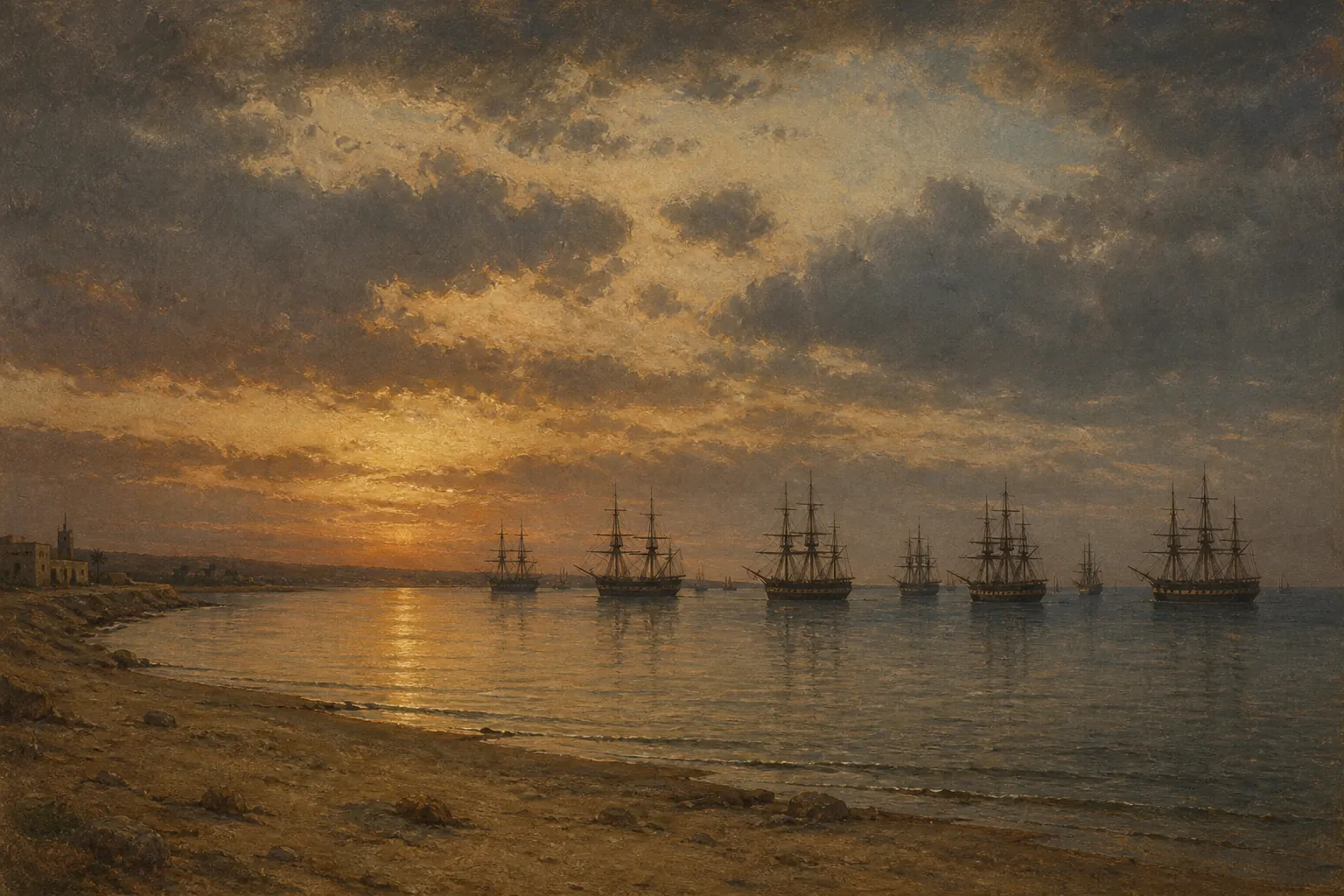 Generated illustration. Not a historical photograph. A fleet at anchor in a shallow bay. Not a photograph of Aboukir.
Overview
On the evening of 1 August 1798 Nelson Horatio — Biography Overview caught the French Mediterranean fleet anchored in Aboukir Bay — Egypt at the mouth of the Nile and destroyed it in a single night action. Of thirteen French ships of the line, eleven were captured or destroyed; the flagship L’Orient — French 120-gun Flagship exploded around 10pm with Brueys aboard. The victory stranded Bonaparte’s army in Egypt, restored Royal Navy dominance in the Mediterranean, and triggered the Second Coalition 1798–1802.
Background and Causes
Bonaparte sailed from Toulon on 19 May 1798 with 35,000 troops and a fleet of 13 ships of the line, headed for Egypt to threaten Britain’s route to India. Nelson, detached from Earl St Vincent’s Cadiz squadron, missed the French at Toulon, Malta, and Alexandria, then returned from a fruitless sweep to Anatolia to find the French fleet anchored at Aboukir on the afternoon of 1 August.
Forces Involved
British (Nelson): thirteen 74-gun third-rates, the 50-gun HMS Leander, and the brig HMS Mutine under Hardy. Flagship HMS Vanguard — Nelson’s Nile Flagship under Captain Berry. Approximately 8,000 men.
French (Brueys): thirteen ships of the line — the 120-gun L’Orient (flag), the 80-gun Franklin, Tonnant, and Guillaume Tell (under Villeneuve), nine 74s — plus four frigates. Anchored bow-to-stern in line ahead from north-west to south-east. Approximately 10,000 men.
Course of Events
Nelson signalled the attack at 3pm with the British fleet still 8 miles distant, choosing to engage at dusk in uncharted shoal water. Captain Thomas Foley in HMS Goliath observed that the French had not run out their inshore guns and led five British ships between the French line and the shore, doubling the French van. The British engaged from both sides while the French rear could not weigh anchor in time.
Action opened at 6:30pm. Nelson was struck on the forehead by langridge from Spartiate around 8:30pm; a flap of skin fell over his face and he believed himself dying, but returned to the quarterdeck before L’Orient caught fire around 9pm. The flagship exploded around 10pm and was lost with most of her crew; firing ceased for ten minutes after the blast. HMS Culloden under Troubridge ran aground entering the bay and never engaged. Villeneuve in Guillaume Tell cut his cables at dawn on 2 August and escaped with three other ships — the only French ships of the line to survive.
Outcome and Casualties
British: 218 killed, 677 wounded. No ships lost. Captain George Westcott of HMS Majestic killed.
French: approximately 1,700 killed including Brueys, around 1,500 wounded, around 3,000 captured. Eleven ships of the line captured or destroyed; only Guillaume Tell, Généreux, and frigates Diane and Justice escaped.
Strategic Consequences
The Nile reversed the Mediterranean balance of naval power overnight. Bonaparte’s army was stranded in Egypt and could not be reinforced or evacuated by sea — Bonaparte himself slipped back to France in August 1799 aboard the frigate Muiron, abandoning his troops. Britain used the prestige of the victory to assemble the Second Coalition 1798–1802, bringing Russia, Austria, the Ottoman Empire, and Naples into the war. Nelson became Baron Nelson of the Nile (6 November 1798) and travelled to Naples — beginning the Hamilton Emma — Biography episode.
Sources
Related
Navigation
Same Campaign — Nelson’s Three Pre-Trafalgar Battles
- Battle of Cape St Vincent 1797 — Overview
- Battle of Copenhagen 1801 — Overview
- Battle of Trafalgar 1805 — Overview
Key People
- Nelson Horatio — Biography Overview
- Hardy Thomas Masterman — Captain HMS Victory
- Villeneuve Pierre-Charles — French Admiral
- Brueys d’Aigalliers François-Paul — French Admiral
- Berry Edward — British Captain
- Troubridge Thomas — British Captain
- Westcott George — British Captain
Ships Involved
- HMS Vanguard — Nelson’s Nile Flagship
- L’Orient — French 120-gun Flagship
- HMS Goliath — 74-gun Third Rate
- HMS Culloden — 74-gun Third Rate
- HMS Majestic — 74-gun Third Rate
- HMS Leander — 50-gun Fourth Rate
- Franklin — French 80-gun Ship
- Tonnant — French 80-gun Ship
- Guillaume Tell — French 80-gun Ship
- Spartiate — French Ship of the Line