HMS Royal Sovereign — Overview
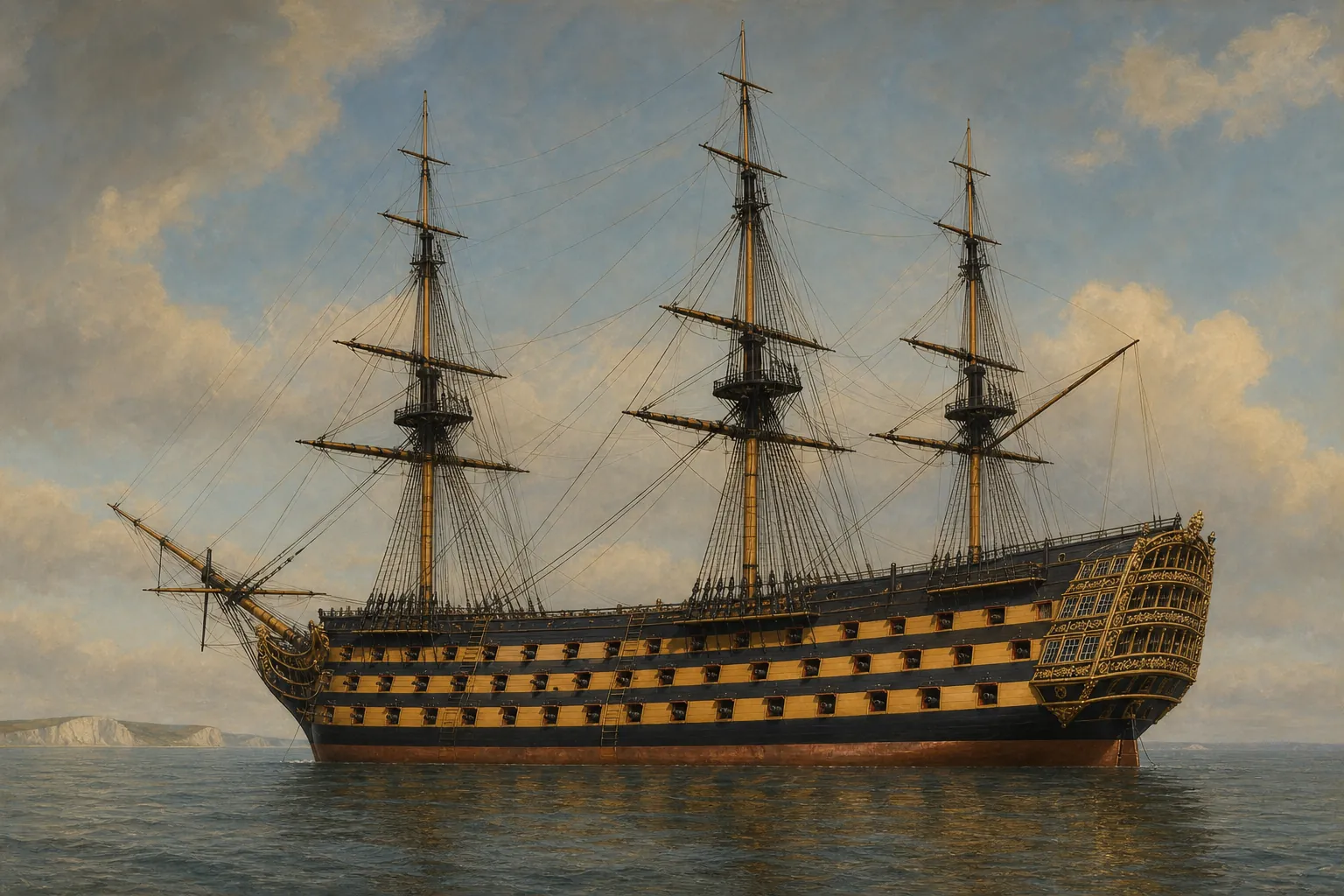 Generated illustration. Not a historical photograph. A first-rate under sail. Not a named-ship portrait.
Overview
HMS Royal Sovereign was a 100-gun First Rate Ship of the Line — Class Overview launched at Plymouth Dockyard on 4 September 1786. She is best remembered as Vice-Admiral Collingwood’s flagship at the Battle of Trafalgar 1805 — Overview, where she led the lee column into action and broke the Franco-Spanish line first, astern of the Spanish three-decker Santa Ana. After long inactive service she was broken up at Plymouth in 1841.
Specifications
| Feature | Detail |
|---|---|
| Rate | First Rate (100 guns) |
| Guns | 100 (as at Trafalgar) |
| Displacement | ~2,175 tons (burthen) |
| Length (gun deck) | 185 ft (56.4 m) |
| Beam | 52 ft (15.8 m) |
| Crew complement | ~837 men |
| Launched | 4 September 1786 |
| Builder | Plymouth Dockyard |
Armament at Trafalgar — Lower deck: 28 × 32-Pounder Naval Cannon; middle deck: 28 × 24-Pounder Naval Cannon; upper deck: 30 × 12-pounders; quarterdeck and forecastle: 14 × 12-pounders plus a battery of carronades.1
Construction / Manufacture
Royal Sovereign was laid down at Plymouth Dockyard in 1774 as a successor to the earlier 1701 ship of the same name, but the American War starved naval construction of resources and her completion was delayed for over a decade. She was finally launched on 4 September 1786 — twelve years on the slip, a strikingly long gestation even by First Rate standards. Designed as an enlargement of Sir Thomas Slade’s late-1750s First Rates (the same lineage as HMS Victory — Overview), she emerged in service as a notoriously sluggish sailer and earned the unaffectionate fleet nickname “the West Country Wagon.”2 A fresh copper bottom applied at Plymouth just before the 1805 campaign transformed her — she joined Collingwood off Cadiz outrunning the rest of the fleet, a turn so complete that on the morning of 21 October she was the first ship into action 3.
Service History
Royal Sovereign’s first major action was the Glorious First of June 1794 — Howe’s Atlantic Victory under Vice-Admiral Thomas Graves and Captain Henry Nicholls, where she fought in Howe’s line against the French Atlantic fleet. Through the long French Wars she served on Channel and Mediterranean station, hoisting Collingwood’s flag in 1805. At Trafalgar she carried the lee column under her flag captain Edward Rotheram. She crossed the Franco-Spanish line astern of Santa Ana (112) around noon, raked the Spanish three-decker with a triple-shotted broadside, and locked alongside her for a two-and-a-half-hour duel that ended with Santa Ana striking. Her own masts went over the side; reduced to a battered hulk, she was towed off by the frigate HMS Euryalus — Frigate, to which Collingwood transferred his flag on Nelson’s death to manage the fleet and the gale that followed.4 After repairs she returned to Channel service, then spent decades in ordinary as harbour and receiving ship before being broken up at Plymouth in 1841.
Significance
Royal Sovereign is the second-most-famous Royal Navy First Rate of the era after Victory — her companion at Trafalgar and her near-contemporary in design lineage. The pairing matters tactically: Nelson’s two-column attack depended on a second flag-officer ship that could carry a column into action without supervision, and Collingwood’s audacious solo lead — opening the battle a quarter-hour before Victory’s column engaged — is one of the iconic images of Age of Sail combat.5 She is also the textbook case of how transformative a clean coppered hull could be: a ship dismissed as a wagon for nineteen years became, briefly, the fastest sailer in Collingwood’s command.
Sources
- @knight2005pursuit — pp. 511–572, Trafalgar campaign
- @adkin2005trafalgar — ship specifications, order of battle, Trafalgar action narrative
- @hughes1957collingwood — Collingwood’s correspondence on the ship and her coppering
Related
Navigation
Same Subject — First-Rates
- HMS Victory — Overview — Nelson’s flagship at the same battle
- Santísima Trinidad — Spanish First Rate — largest warship in the world, captured at Trafalgar
- Royal Sovereign 1701 Predecessor — 1701 namesake and 1841 breaking-up only
Key People
- Collingwood Cuthbert — Biography — her flag officer at Trafalgar
- Nelson Horatio — Biography Overview — commander-in-chief and second-in-command relationship
- Rotheram Edward — Captain HMS Royal Sovereign — her flag captain at Trafalgar
Key Battles
- Battle of Trafalgar 1805 — Overview — her most famous action
- Glorious First of June 1794 — Howe’s Atlantic Victory — her earlier major action
Cross-Domain
- Royal Navy — Institutional Overview
- Age of Sail — Era Overview
- Plymouth Dockyard
- Copper Sheathing — Hull Protection
- Royal Sovereign Coppering — Plymouth 1805 — 1805 Plymouth coppering only
- Royal Sovereign Quarter-Hour Lead — 21 October 1805 — interval only
- Royal Sovereign Armament — Trafalgar — those counts only
- 32-Pounder Naval Cannon
- First Rate Ship of the Line — Class Overview
- Line of Battle — Naval Tactic
Footnotes
-
Armament summary per Adkin 2005, ship plates in the Trafalgar order of battle section. ↩
-
Nickname recorded in Hughes 1957, drawn from Collingwood’s correspondence with his brother Wilfred prior to her 1805 refit; cf. also Adkin 2005 on her pre-coppering sailing qualities. ↩
-
Knight 2005, pp. 511–572 on the fresh coppering and her unexpected speed off Cadiz; Adkin 2005 corroborates from Rotheram’s log. ↩
-
Adkin 2005 (Trafalgar narrative); Knight 2005, pp. 511–572 on the dismasting and Euryalus tow. ↩
-
Knight 2005, pp. 511–572; Hughes 1957 on Collingwood’s quarterdeck remark “What would Nelson give to be here?” ↩