32-Pounder Naval Cannon
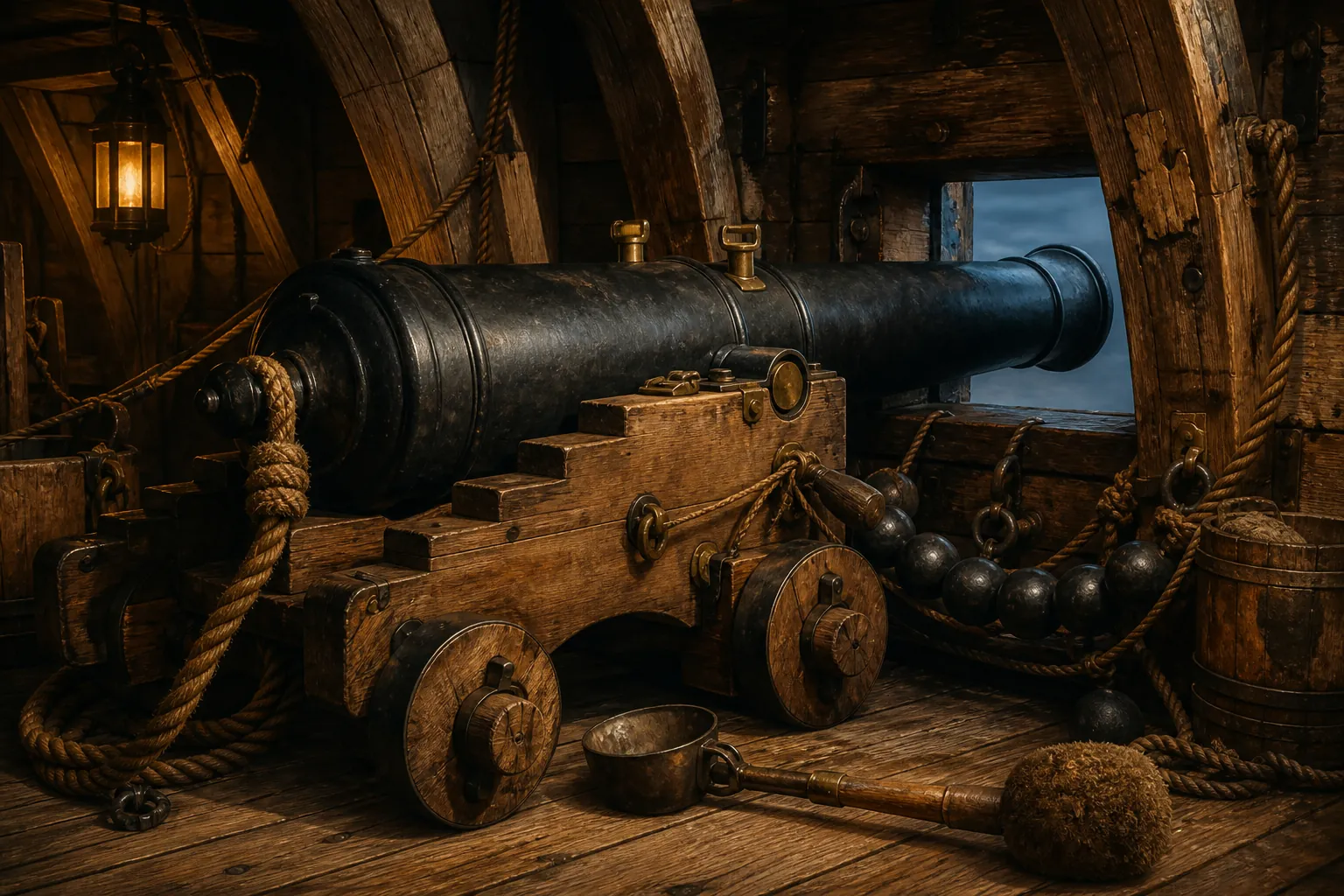 Generated illustration. Not a historical photograph. 32-pounder on a truck carriage, gun deck.
Overview
The 32-pounder was the heaviest standard gun in the Royal Navy — Institutional Overview during the Age of Sail — a weapon of terrifying power at close range, weighing over 3 tons and requiring a crew of 15 trained men to serve effectively. It fired a solid iron ball weighing 32 pounds (14.5 kg) with enough force to penetrate several feet of oak at 400 yards. HMS Victory — Overview carried 30 of them on her lower gun deck.
Specifications
| Feature | Detail |
|---|---|
| Bore | 6.41 inches |
| Ball weight | 32 lbs (14.5 kg) |
| Barrel length | 9 ft 6 in |
| Weight of piece | ~3 tons 8 cwt |
| Effective range | ~400 yards |
| Maximum range | ~1,200 yards |
| Rate of fire | 1–2 rounds per minute (experienced crew) |
| Crew required | 15 men |
| Powder charge | 10 lbs |
Construction and Manufacture
32-pounders were cast at foundries including the Carron Company — Falkirk Foundry in Scotland and Walker Foundry — Rotherham. The casting process involved pouring molten iron into a vertical mould, allowing it to cool, then boring the barrel on a horse-powered boring mill. Early casting produced unreliable metal — burst barrels killed their own crews. The Royal Brass Foundry — Woolwich and improved boring techniques developed by Wilkinson John — Iron Founder during the 1770s dramatically improved reliability.
The gun was mounted on a Naval Gun Carriage — Truck Carriage — a compact four-wheeled wooden carriage that allowed the gun to recoil inboard on firing, be reloaded, and be run back out through the gunport.
Tactical Use
On a First Rate Ship of the Line — Class Overview, the lower gun deck carried the 32-pounders — the heaviest and most powerful armament. In battle, the target was the enemy hull at point-blank range. At 50–100 yards, a 32-pound iron ball could pass through the entire width of a ship’s hull, turning oak and crew members into lethal splinters. More men were killed by Wooden Splinters — Naval Wound Type than by the balls themselves.
Ammunition Types
- Round shot — solid iron ball, primary anti-hull ammunition
- Chain shot — two balls connected by chain, designed to cut rigging and masts
- Bar shot — two hemispheres on a bar, same anti-rigging purpose
- Grape shot — cluster of smaller balls in a canvas bag, anti-personnel at close range
- Canister shot — tin can of musket balls, devastating against deck crew
Failure Modes
Burst barrels (usually from casting defects or overcharging). Misfires from damp powder or faulty flint. Vent erosion from repeated firing. Overheating after sustained action — guns were cooled with wet sponges between shots.
Sources
Related
Navigation
Related Weapons
Ships That Carried This
Cross-Domain
- Carron Company — Falkirk Foundry
- Naval Gun Carriage — Truck Carriage
- Wooden Splinters — Naval Wound Type
- Chain Shot — Anti-Rigging — 32-pounder type only
- Bar Shot — Anti-Rigging — 32-pounder type only
- Canister Shot — Anti-Personnel — 32-pounder type only