Bucentaure — Overview
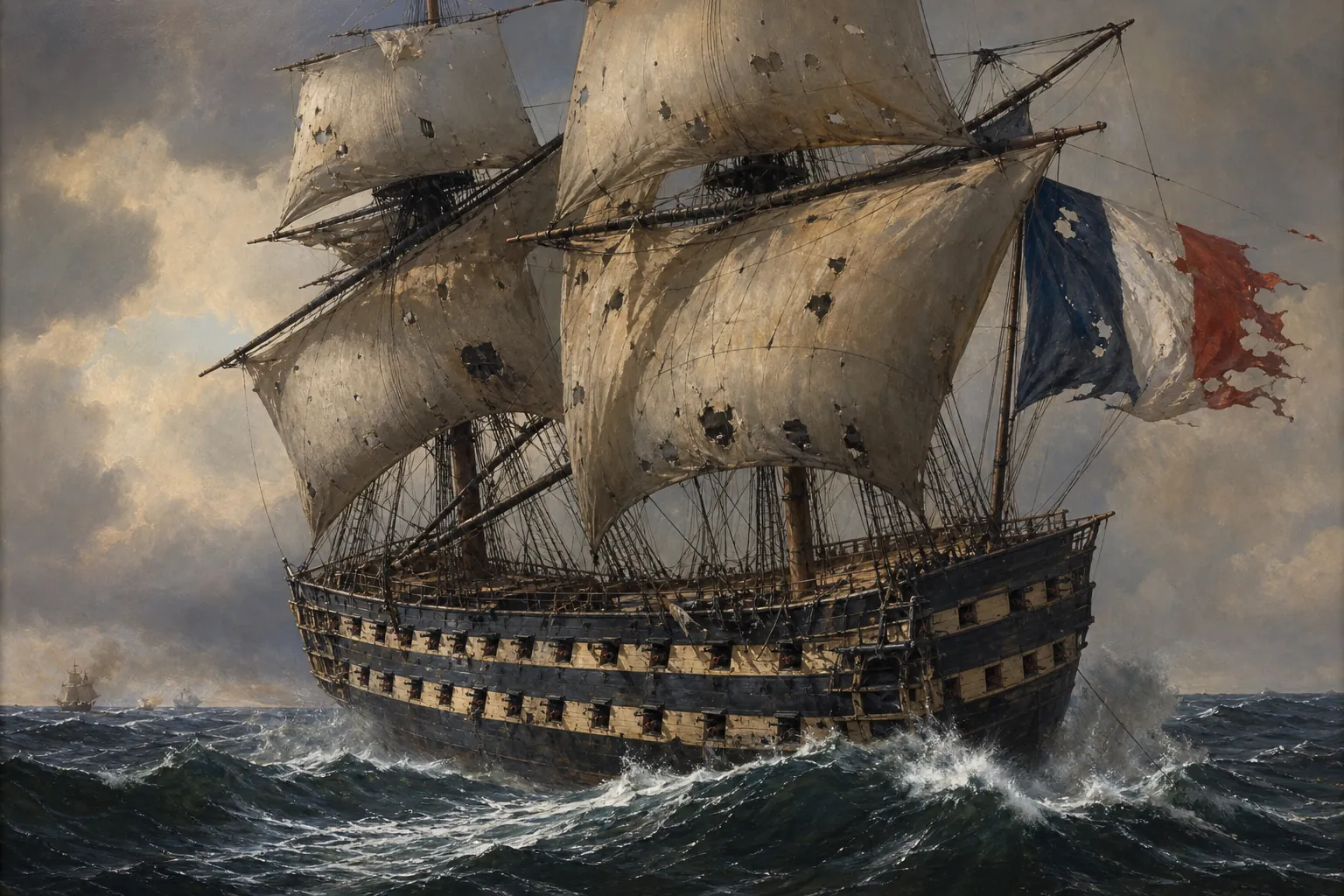 Generated illustration. Not a historical photograph. A French two-decker of the Trafalgar generation. Not a named-ship portrait.
Overview
Bucentaure was a French 80-gun Téméraire-class two-decker built at Toulon in 1803 and serving barely two years before her capture and loss. She flew the flag of Vice-Admiral Pierre-Charles Villeneuve as the central flagship of the Franco-Spanish Combined Fleet at the Battle of Trafalgar 1805 — Overview, where she was raked and dismasted, surrendered to HMS Conqueror, and was wrecked in the post-battle storm.1
Specifications
| Feature | Detail |
|---|---|
| Rate | French third-rate (80-gun two-decker) |
| Class | Téméraire-class (design by Jacques-Noël Sané) |
| Guns | 80 (nominal) |
| Lower gun deck | 30 × 36-pounder long guns |
| Upper gun deck | 32 × 24-pounder long guns |
| Quarterdeck / forecastle | 18 × 8-pounders + 6 × 36-pounder obusiers (carronade-pattern) |
| Displacement | ~1,900 tons |
| Length (gun deck) | ~57 m (187 ft) |
| Beam | ~15 m (49 ft) |
| Crew | ~840 (Trafalgar complement, including troops) |
| Launched | July 1803, Toulon |
| Builder | Toulon Naval Arsenal |
French naval doctrine in this period preferred the heavy 80-gun two-decker over the British three-decker first-rate, holding that two decks gave better seakeeping, faster handling, and a more reliable lower battery in heavy weather than the towering three-deckers’ high freeboard allowed.2
Construction / Manufacture
Bucentaure was a Téméraire-class vessel, the standard French heavy two-decker designed by Jacques-Noël Sané in 1782. The class produced sixteen ships across the Revolutionary and Napoleonic period; one of them, the original Téméraire (1782), was captured by the Royal Navy in 1759 and gave her name to the British 98-gun HMS Téméraire of Turner’s painting.3 Bucentaure was laid down at the Toulon Arsenal during the Consulate’s naval rebuild after the Revolution’s officer-corps purges and the Nile losses, launched in July 1803 and completed for sea in 1804.4
Service History
Bucentaure’s career was brief. After commissioning she joined the Toulon squadron. On the death of Vice-Admiral Latouche-Tréville in August 1804, Napoleon transferred command of the Toulon fleet — and the new flagship — to Villeneuve. She sailed from Toulon on 29 March 1805 on the trans-Atlantic feint toward Martinique, recrossed the Atlantic, fought at the inconclusive Battle of Cape Finisterre 1805 under Calder on 22 July 1805, and retired to Cadiz where she was blockaded until 19 October.5
At Trafalgar on 21 October 1805, Bucentaure lay near the centre of the Franco-Spanish line. HMS Victory — Overview passed under her stern at approximately 12:30 and delivered a double-shotted raking broadside down the length of her gun decks — Knight notes the single most destructive moment of the battle, killing or wounding scores at once and dismounting roughly twenty guns.6 In nearly three hours of close action Bucentaure was dismasted entirely. Reportedly the only senior officer aboard not wounded, Villeneuve surrendered to a boarding party from HMS Conqueror.7
She was taken in tow as a prize, but the great gale of 24–29 October overwhelmed her: sources differ on whether she was wrecked on the Spanish coast near Cadiz or scuttled by her prize crew to prevent recapture.8 No British or French account places her at a single agreed loss-site; she is “lost in the storm” by general consensus.
Significance
Bucentaure embodies the French naval position at its 1805 high-water mark: a modern, well-built, heavily-gunned two-decker, manned by a fleet that could not match the Royal Navy’s seamanship or gunnery rates. Her capture and immediate loss mirror the wider verdict of Trafalgar — material parity, doctrinal divergence, decisive British execution. Set against Victory and Royal Sovereign at the same battle, she is the French peer that completes the trio of Trafalgar flagships.
Sources
Related
Navigation
Same Subject — Trafalgar Flagships
- HMS Victory — Overview — Nelson’s flagship at the same battle
- HMS Royal Sovereign — Overview — Collingwood’s flagship leading the lee column
Key People
- Villeneuve Pierre-Charles — French Admiral — her flag officer at Trafalgar
- Latouche-Tréville Louis-René — French Admiral — earlier intended Toulon-fleet commander
- Magon de Médine Charles — French Rear-Admiral Killed at Trafalgar — Combined Fleet rear-admiral
- James Atcherley — Took Villeneuve’s Sword — sword-taking only
Key Battles
- Battle of Trafalgar 1805 — Overview — her capture and loss
- Battle of Cape Finisterre 1805 — the Trafalgar prelude action she fought in
Cross-Domain
- Age of Sail — Era Overview
- Toulon Arsenal — French Naval Construction Centre
- Téméraire-Class Two-Deckers — French Naval Doctrine
- HMS Conqueror — Overview — 74-gun third-rate; her boarding party under Capt. James Atcherley took Villeneuve’s surrender
- Storm After Trafalgar — 24–29 October 1805
- HMS Téméraire — Trafalgar 98-gun Second Rate
Footnotes
-
Knight, Pursuit of Victory (2005), pp. 511–572; Adkin, Trafalgar Companion (2005), pp. 286–323. Both authorities agree on capture, dismasting, and post-battle loss; the exact loss-site is contested (see 8). ↩
-
Adkin, Trafalgar Companion (2005), pp. 76–82, on French two-decker doctrine and the Téméraire-class. Treat the doctrinal claim as
status/draft— French archival sources beyond Adkin not yet consulted. ↩ -
Adkin, Trafalgar Companion (2005), p. 78, on Téméraire-class lineage and the British capture of the name-ship. ↩
-
Adkin, Trafalgar Companion (2005), pp. 286–290, Toulon construction window and commissioning. ↩
-
Knight, Pursuit of Victory (2005), pp. 480–510, on the Trafalgar Campaign movements and the Calder action; Adkin, pp. 250–285. ↩
-
Knight, Pursuit of Victory (2005), pp. 540–545, on Victory’s raking broadside into Bucentaure. ↩
-
Adkin, Trafalgar Companion (2005), p. 310; HMS Conqueror’s boarding party under Capt. James Atcherley took Villeneuve’s sword. ↩
-
status/contested: Knight, Pursuit of Victory (2005), pp. 565–570, and Adkin, Trafalgar Companion (2005), pp. 320–323, both place her loss in the 24–29 October storm but differ in detail. No verbatim primary-source loss report consulted yet — flagged for re-research. ↩ ↩2