Battle of Cape Finisterre 1805
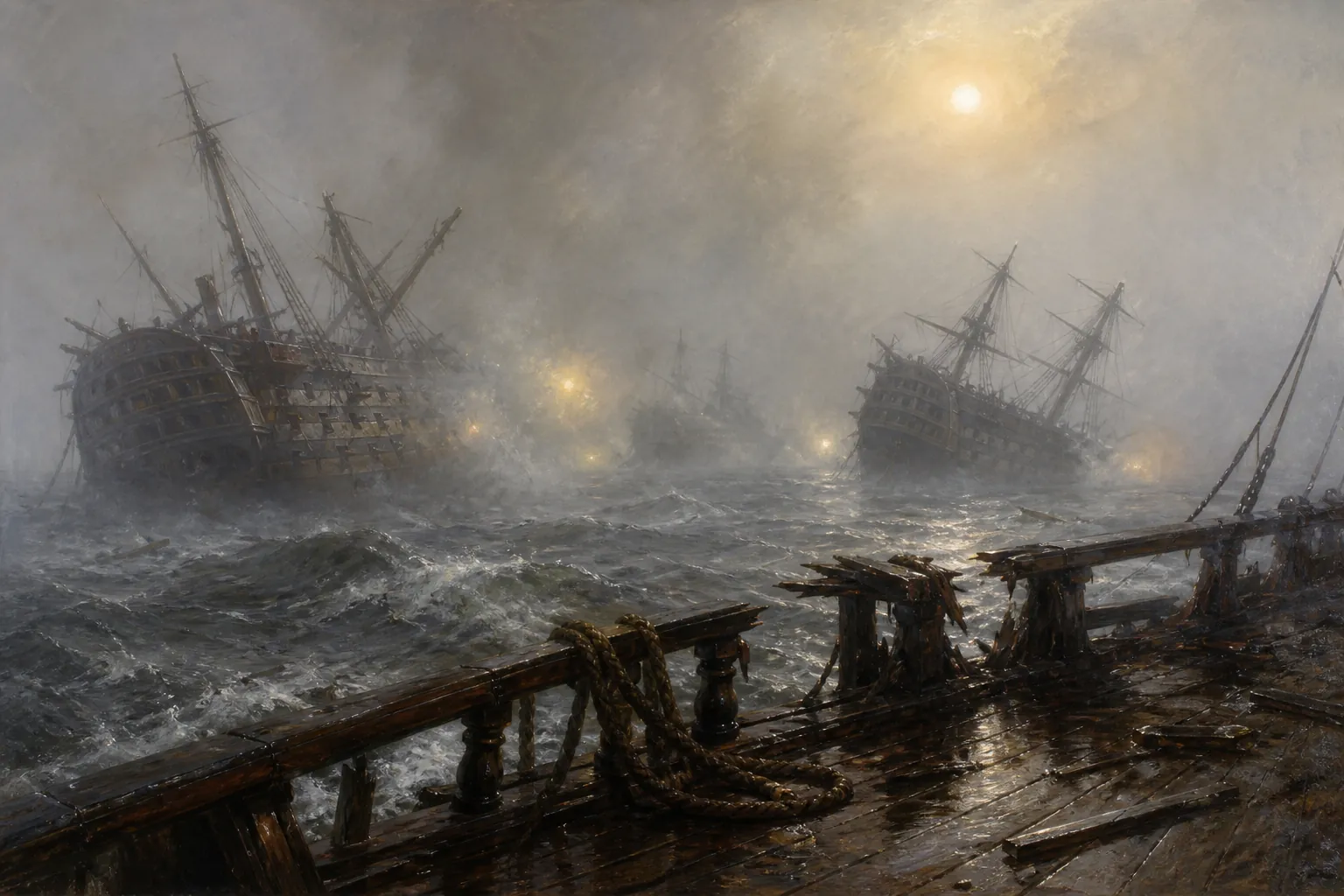 Generated illustration. Not a historical photograph. Fog-bound fleet action off Cape Finisterre, 22 July 1805.
Overview
On 22 July 1805, Vice-Admiral Sir Robert Calder fought Villeneuve Pierre-Charles — French Admiral’s Combined Fleet in fog off Cape Finisterre as that fleet came back from the West Indies. The action is the operational hinge of the Trafalgar Campaign 1805: two Spanish ships were taken, neither admiral fought a second day, and Villeneuve went south instead of on to Brest.1
Background and Causes
Villeneuve had left Toulon on 29 March, joined Gravina Federico — Spanish Admiral at Cadiz — Spanish Naval Port, and crossed the Atlantic to draw Nelson Horatio — Biography Overview west. The return to Europe was the moment the invasion plan still needed a junction with the Brest fleet. Calder was taken off the Rochefort and Ferrol blockades to intercept.
Forces Involved
British (Calder): 15 ships of the line. Adkin’s companion is the vault’s order-of-battle reference for the 1805 fleets.2
Franco-Spanish (Villeneuve): 20 ships of the line (14 French, 6 Spanish), including Bucentaure — Overview as Villeneuve’s flag. Gravina commanded the Spanish contingent.
Course of Events
The fleets sighted each other in the morning. Wind and fog delayed a general action until late afternoon. The fighting became a melee in failing light. Two Spanish ships of the line, San Rafael (80) and Firme (74), were taken. Calder broke off toward night, intending to fight again. On 23–24 July he did not renew, citing damaged ships, the prizes, and the risk that the Ferrol squadron would come out. Villeneuve, with the wind in his favour on the 24th, also declined and turned south.3
Outcome and Casualties
No British ship was lost. British killed and wounded are commonly given as 41 and 162. Combined-fleet killed and wounded figures do not agree across secondary accounts (low hundreds in some, higher in others, plus a large sick list). Two Spanish ships were captured. Treat the Combined casualty total as status/contested until a primary return is entered in 90_Primary_Documents.
Calder was later court-martialled and reprimanded for not renewing. He did not hoist his flag at sea again. Villeneuve put into Vigo and Coruña, then Cadiz.
Strategic Consequences
The action did not “win” 1805. It ended the invasion sequence. A Combined Fleet that did not go to Brest could not open the Channel. Napoleon’s army left Boulogne for the German campaign. The same ships next fought the Battle of Trafalgar 1805 — Overview on 21 October.
Sources
- @knight2005pursuit — Trafalgar campaign chapter, pp. 511–572
- @adkin2005trafalgar — 1805 companion (ships, officers, sequence)
- @white2005nelson — already used on the Villeneuve and Trafalgar notes this action sits between
Related
Navigation
Same Campaign
- Trafalgar Campaign 1805 — the operational frame this action belongs to
- Battle of Trafalgar 1805 — Overview — the October battle the Combined Fleet sailed to after Cadiz
Key People
- Calder Robert — British Admiral — British commander, 22 July 1805
- Villeneuve Pierre-Charles — French Admiral — opposing Combined Fleet commander
- Gravina Federico — Spanish Admiral — Spanish second-in-command
- Nelson Horatio — Biography Overview — still in the Atlantic chase, not present in the line
Ships Involved
- Bucentaure — Overview — Villeneuve’s flag, present
- San Rafael — Spanish 80 — captured, 22 July 1805
- Firme — Spanish 74 — captured, 22 July 1805
Cross-Domain
- Cadiz — Spanish Naval Port — where Villeneuve ended after turning south
- Royal Navy — Institutional Overview — blockade and court-martial system
- Age of Sail — Era Overview
- Finisterre Prizes — 22 July 1805
Footnotes
-
Campaign placement: @knight2005pursuit pp. 511–572. Sequence already on Villeneuve Pierre-Charles — French Admiral from @adkin2005trafalgar and @white2005nelson. ↩
-
@adkin2005trafalgar is the vault’s encyclopedic 1805 OOB companion. Wikipedia (discovery only) points at Adkin p. 56 for the Malta melee; that page number is not independently verified here. ↩
-
Villeneuve’s refusal to renew with the wind, and the turn toward Cadiz, is already stated on his biography from Adkin and White. Calder’s court-martial and reprimand are the standard secondary aftermath; a primary minute of the court is not yet in
90_Primary_Documents. ↩