Age of Sail — Era Overview
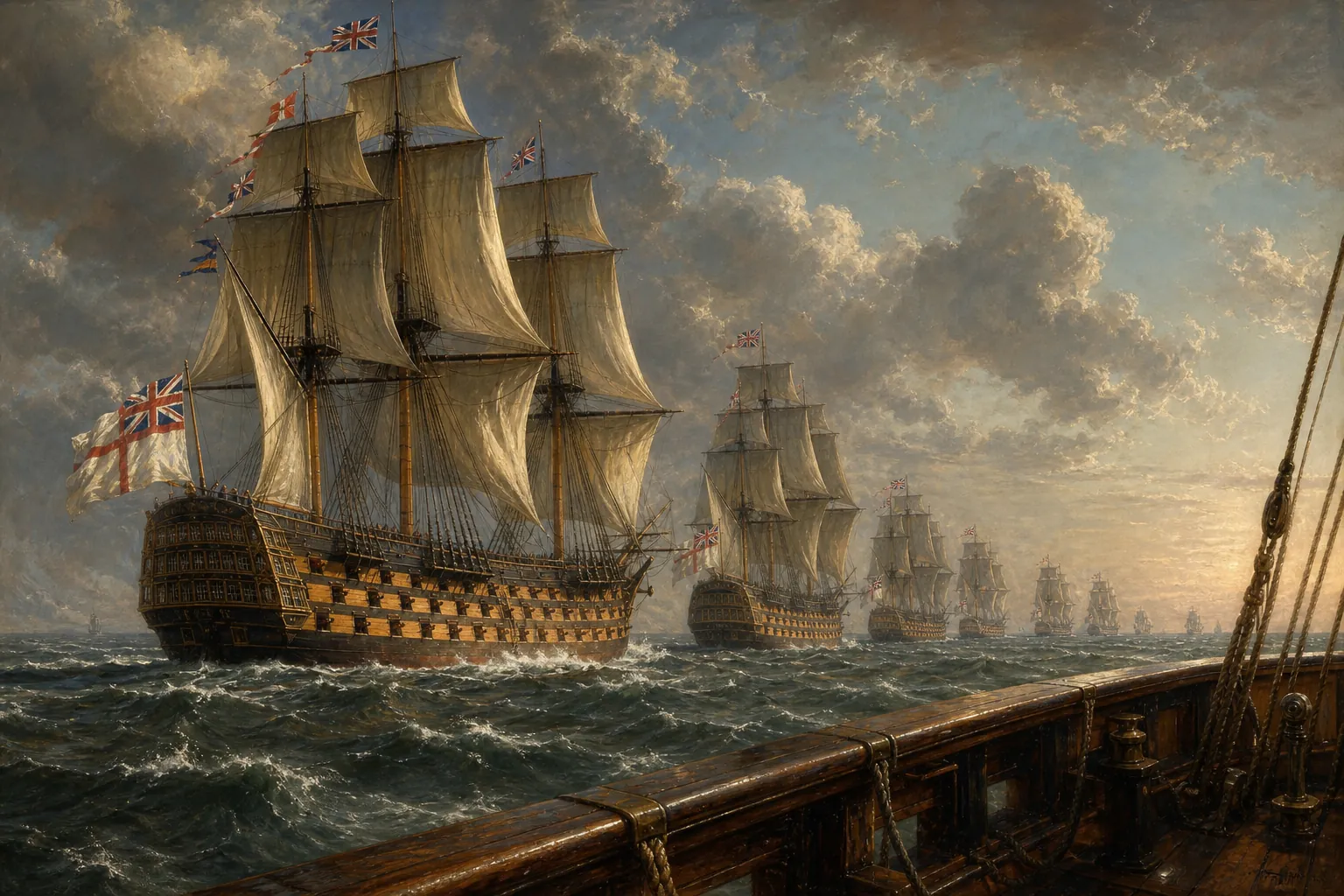 Generated illustration. Not a historical photograph. A fleet of ships of the line in line-ahead.
Claim
The Age of Sail (approximately 1650–1815) was the period in which wooden, cannon-armed sailing warships were the dominant instrument of global military power. It ended with the defeat of Napoleon and the technological transitions of the early industrial revolution — steam power, iron hulls, and shell-firing guns.
Reasoning
Naval power during this era was decisive. The nation that controlled the sea lanes controlled trade, colonies, and the ability to project military force anywhere in the world. Britain’s mastery of the Age of Sail translated directly into the British Empire. The Royal Navy — Institutional Overview was the instrument of that mastery.
Evidence
Key characteristics of the era:
- Ships: Ship of the Line — Tactical Concept — rated warships from First Rate Ship of the Line — Class Overview (100+ guns) to Sixth Rate Ship of the Line — Class Overview (less than 28 guns), plus unrated Sloops, Brigs, and Frigates — Overview
- Tactics: Line of Battle — Naval Tactic — ships formed a single line to bring maximum broadside firepower to bear. The line was the dominant tactical doctrine from the 1650s until Nelson broke it at Battle of Trafalgar 1805 — Overview
- Navigation: Celestial Navigation — Age of Sail, the Longitude Problem — Resolution 1759, and the Marine Chronometer — Harrison’s Solution
- Geography: Atlantic, Mediterranean, Caribbean, and Indian Ocean were the decisive theatres
The Era’s Boundaries
The era opens approximately with the Anglo-Dutch Wars (1652–1674), which established fleet tactics and line-of-battle doctrine. It closes with the Battle of Trafalgar 1805 — Overview and the subsequent Napoleonic Wars — Overview. The first steam-powered warship, Demologos — First Steam Warship, was launched in 1814 — the era was already ending.
What Defined the Era
- Wood and canvas as the technology of war
- Wind as the source of strategic mobility
- Iron cannon as the weapon of decision
- Prize money as the incentive structure
- Press gangs and harsh discipline as the manning system
- Global reach — a British fleet could appear anywhere in the world within months
Sources
Related
Navigation
Related Era Notes
- Early_Modern — Era Overview
- Napoleonic Wars — Overview
- Trafalgar Campaign 1805 — 1805 operational frame now filled
Key Subjects From This Era
- Age of Sail — Chronological Timeline — dated facts already in the vault
- Eshelby’s Surgical Log — 24 July 1797 — first filled official-record note
- Yellow Punishment Coat — Greenwich Hospital — first filled naval-dress note
- Copper Sheathing — Hull Protection — first filled shipbuilding-materials note
- Cutting-Out of La Mutine — May 1797 — first filled irregular-warfare note
- Slade Thomas — Naval Architect — first filled naval-architecture note
- Press Gang — Naval Impressment System — first filled logistics note
- Crewkerne Grammar School — first filled education-training note
- English Oak — Shipbuilding Timber — first filled resources-production note
- Hamilton Emma — Biography — first filled cultural-figures note
- Board of Admiralty — London — first filled government-systems note
- Portsmouth Historic Dockyard — first filled museums-archives note
- Post-Captain Seniority List — first filled class-social-structure note
- Horatia Nelson — Biography — first filled women-gender note
- St Paul’s Cathedral — London — first filled institutional-religion note
- Acorn Planting Tradition — Collingwood Oaks — first filled agriculture-food-systems note
- Q — Did Nelson really say “blind eye” at Copenhagen — first filled historiography note
- Q — Was it Kiss me Hardy or Kismet Hardy — first filled popular-culture note
- Denmark — Armed Neutrality Partner 1800–1801 — first filled european-powers note
- Nelson’s Phantom Limb — Belief in the Soul — first filled popular-belief note
- Sword Raised at Santa Cruz — 24 July 1797 — first filled small-arms-edged note
- Nelson–Hamilton Affair — Press Sensation — first filled press-information note
- Egypt Expedition — Threat to the India Route 1798 — first filled colonial-empires note
- Channel Buoys — Copenhagen 2 April 1801 — first filled cartography note
- Turner — Fighting Temeraire Named — first filled art-literature note
- Ottoman Empire — Second Coalition Partner 1798 — first filled asian-powers note
- Malaria — Nelson in the Caribbean — first filled disease-nutrition note
- Nelson’s State Funeral — Body Brought Home — first filled religion-and-state note
- Nelson as National Saint — Trafalgar Myth — first filled mythology-sacred-figures note
- Nelson Personal Life — Propaganda Machine — first filled propaganda-media note
- Armed Neutrality — Neutral Shipping Rights — first filled political-ideology note
- News of Paul I’s Death — Not Yet Arrived — first filled postal-dispatch note
- Horse-Powered Boring Mill — 32-Pounder Barrels — first filled engineering-innovation note
- Royal Dockyards — Largest Industrial Enterprises — first filled industry-labour note
- Age of Sail Close — Steam, Iron, and Shell — first filled modern note
- Royal Brass Foundry — Woolwich — Woolwich foundry credit; overflow into Metallurgy_Foundries
- HMS Euryalus — Frigate — Collingwood flag-shift and Royal Sovereign tow
- HMS Conqueror — Overview — boarding party took Villeneuve’s surrender
- 68-Pounder Carronade — Victory quarterdeck/forecastle credit only
- Rotheram Edward — Captain HMS Royal Sovereign — Trafalgar flag captain; posting only
- Plymouth Dockyard — Royal Sovereign laid down 1774; launched 4 September 1786
- Mediterranean Fleet 1805–10 — Collingwood Mediterranean command from April 1806
- Chatham Dockyard — Victory laid down 1759; launched 7 May 1765
- Trafalgar Square — London — memorials at Portsmouth and Trafalgar Square
- HMS Téméraire — Trafalgar 98-gun Second Rate — British 98-gun namesake of Turner’s painting
- Toulon Fleet 1804–05 — Villeneuve Toulon command from August 1804
- Burnham Thorpe — Norfolk Village — Nelson born 29 September 1758
- Nelson’s Touch — Command Philosophy — pre-battle briefing only
- West Country Wagon — Royal Sovereign Nickname — sluggish-sailer nickname only
- Santa Ana — Spanish 112-gun First Rate — 112-gun; Trafalgar duel with Royal Sovereign
- 12-Pounder Naval Cannon — Victory 12-pounder credit only
- Kingston Russell House — Dorset — Hardy born 5 April 1769
- Berkeley Anne Louisa — Lady Hardy — Halifax marriage, November 1807
- Sarah Blackett Collingwood — Lady Collingwood — June 1791 marriage only
- Hôtel de la Patrie — Rennes — Villeneuve death-place, April 1806
- Royal Grammar School Newcastle — Collingwood schooling only
- Suckling Maurice — Captain — Nelson uncle-entry only
- Nelson Stature — Five Feet Six — 5 ft 6 in only
- Holsteen — Danish 60 — Copenhagen prize; 60 only
- Port Mahon — Menorca — Collingwood death-place, 7 March 1810
- Valensole — Provence — Villeneuve born 31 December 1763
- HMS Helena — Brig — Hardy captain’s servant, November 1781; brig only
- Baron Nelson of the Nile — 6 November 1798 — Nile barony only
- Baron Collingwood of Caldburne and Hethpool — 9 November 1805 — Trafalgar barony only
- Hardy Baronet — 1806 — 1806 baronetcy only
- Cartagena — Spanish Naval Port — Córdova sailed 1 February 1797
- Cape St Vincent — Geography — 14 February 1797 location only
- Martinique — 1805 Atlantic Feint — Villeneuve crossed to draw Nelson west
- Corsica — Evacuated November 1796 — Jervis withdrew to the Tagus
- Nelson Post-Captain — 1779 — youngest post-captain, aged 20
- Earl of St Vincent — 1797 — Jervis earldom only
- Cape Finisterre — Geography — 22 July 1805 location only
- Brest — Intended 1805 Junction — Villeneuve went south instead of on to Brest
- Boulogne — 1805 Invasion Camp — army waited then marched east
- Morlaix — 18 April 1806 — Villeneuve repatriation
- Genoa and the Hyères Islands — 1795 — Hardy 1795 actions only
- Hardy Flag-Captain Victory — 31 July 1803 — posting date only
- Demologos — First Steam Warship — 1814 American first steam warship only
- Madrid — Rosily 18 October 1805 — Rosily at Madrid with relief orders
- Villeneuve Reinstated — May 1795 — reinstatement only
- Suffren — Indian Ocean 1782–83 — Villeneuve service only
- Collingwood Succeeds Nelson — 1779–1780 — Badger 1779 / Hinchinbrook 1780 succession only
- Signal 16 — Copenhagen 2 April 1801 — engage more closely only
- Cadiz Blockade — Nelson 1805 — late-August 1805 command only
- George Collingwood — Hanged at Liverpool 1716 — hanging only
- Hardy Shoe-Buckle — Trafalgar 21 October 1805 — buckle only
- Nelson Decorations — Trafalgar Coat — Trafalgar wearing only
- Calder Captain of the Fleet — 14 February 1797 — posting only
- Foley Captain Elephant — 2 April 1801 — posting only
- HMS Victory — Never Fired in Anger After Trafalgar — end of fighting service only
- Hyde Parker Recalled — After Copenhagen 1801 — recall only
- Bishop’s Waltham — Hampshire Parole Town — parole-place only
- Tagus — Jervis Withdrawal 1796 — November 1796 withdrawal only
- Collingwood Rear-Admiral and Vice-Admiral — 1799–1804 — February 1799 / April 1804 only
- Villeneuve Garde de la Marine — 1778 — 1778 entry only
- Villeneuve Vice-Admiral — May 1804 — May 1804 rank step only
- Arc de Triomphe — Villeneuve Inscription — inscription only
- Collingwood Navy Entry — 1761 — 1761 entry only
- Holstein — Later Name of Holsteen — later name only
- Malta — Missed 1798 — miss-place only
- Newcastle upon Tyne — Collingwood Birthplace — birthplace only
- Pitt and Addington — Baltic Fleet 1801 — dispatch only
- Signal 39 — Copenhagen 2 April 1801 — discontinue hoist only
- Nelson State Funeral — 9 January 1806 — date only
- Villeneuve Sortie — 19 October 1805 — sortie only
- Vigo and Coruña — Villeneuve Put-Ins 1805 — put-ins only
- Rochefort and Ferrol — Calder Taken Off 1805 — taking-off only
- Anatolia — Fruitless Sweep 1798 — sweep only
- Collingwood Relief Refused — refusal only
- Finisterre Fog — 22 July 1805 — fog delay only
- Hardy KCB — 1815 — later honour only
- Anglo-Dutch Wars — Era Opening 1652–1674 — opening only
- Hardy South America Station — 1819–1824 — posting only
- Collingwood Anchor Decision — After Trafalgar — decision only
- Nelson Unfit for Command — After Tenerife 1797 — assessment only
- Jervis Signal — Drive Between 11am 1797 — 11am hoist only
- Cape St Vincent Squalls — 14 February 1797 — squalls only
- Cape Trafalgar — Tarif al-Gharb — Arabic name only
- Nile Attack Signal — 3pm 1 August 1798 — 3pm hoist only
- L’Orient Cease-Fire — Ten Minutes 1 August 1798 — ten-minute pause only
- Halifax — Hardy Marriage 1807 — marriage-place only
- Nelson Horatio — Biography Overview
- Royal Navy — Institutional Overview
- HMS Victory — Overview
- First Rate Ship of the Line — Class Overview — first filled class note
- Redoutable — French 74-gun Ship
- HMS Captain — 74-gun Third Rate
- Santísima Trinidad — Spanish First Rate
- Line of Battle — Naval Tactic — first filled tactics note
- L’Orient — French 120-gun Flagship
- Aboukir Bay — Egypt
- Cadiz — Spanish Naval Port — first filled port note
- Hyde Parker — British Admiral
- HMS Elephant — 74-gun Third Rate
- Copenhagen — Denmark — first filled city note
- Brueys d’Aigalliers François-Paul — French Admiral
- Fischer Olfert — Danish Commodore
- HMS Agamemnon — Overview
- England Expects Signal — Trafalgar 1805
- Battle of Trafalgar 1805 — Death of Nelson
- Trekroner Fort — Copenhagen
- HMS Goliath — 74-gun Third Rate
- HMS Vanguard — Nelson’s Nile Flagship
- Nelson’s Prayer Before Trafalgar — Text, Context, and Providential Belief
- Foley Thomas — British Captain
- King’s Deep Soundings — Copenhagen 1 April 1801
- Berry Edward — British Captain
- HMS Culloden — 74-gun Third Rate
- Nelson’s Patent Bridge for Boarding First Rates
- HMS Excellent — 74-gun Third Rate
- Four Spanish Prizes of Cape St Vincent 1797
- League of Armed Neutrality of the North 1800–1801
- Troubridge Thomas — British Captain
- Treaty of San Ildefonso 1796
- Baltic Naval Stores — 1800–1801
- Córdova José de — Spanish Admiral
- Calder Robert — British Admiral
- Stewart William — Lt-Col
- Crown Prince Frederik — Denmark
- Second Coalition 1798–1802
- Egyptian Expedition 1798–1801
- Finisterre Prizes — 22 July 1805
- San José — Spanish 112-gun First Rate
- San Nicolás — Spanish 84-gun Third Rate
- Salvador del Mundo — Spanish 112-gun First Rate
- San Ysidro — Spanish 74-gun Third Rate
- Tsar Paul I of Russia
- Tsar Alexander I of Russia
- Westcott George — British Captain
- HMS Majestic — 74-gun Third Rate
- San Rafael — Spanish 80
- Firme — Spanish 74
- Guillaume Tell — French 80-gun Ship
- Franklin — French 80-gun Ship
- Tonnant — French 80-gun Ship
- Spartiate — French Ship of the Line
- HMS Leander — 50-gun Fourth Rate
- Príncipe de Asturias — Spanish First Rate
- Généreux — French Ship of the Line
- Diane — French Frigate
- Justice — French Frigate
- HMS Mutine — Captured French Brig
- HMS Theseus — Overview
- Eshelby Thomas — Surgeon HMS Theseus
- Téméraire-Class Two-Deckers — French Naval Doctrine
- Sané Jacques-Noël — French Naval Architect
- Toulon Arsenal — French Naval Construction Centre
- Strait of Gibraltar — Strategic Waterway
- HMS Foudroyant — 80-gun Third Rate
- HMS Minerve — Frigate
- Muiron — French Frigate
- 36-Pounder Long Gun — French Naval Standard
- Langridge — 1 August 1798
- Hardy Monument — Black Down
- HMS St George — 98-gun Second Rate
- Amputation Surgery at Sea — 18th Century
- Santa Cruz de Tenerife — Spanish Port
- Naval Gun Carriage — Truck Carriage
- Wooden Splinters — Naval Wound Type
- Greenwich Hospital — Royal Hospital for Seamen
- Calder Court-Martial — Finisterre Aftermath
- Knight of the Bath — Nelson 1797
- Rear-Admiral — Nelson after Cape St Vincent
- Carron Company — Falkirk Foundry
- Gunpowder — Naval Propellant
- 24-Pounder Naval Cannon