Line of Battle — Naval Tactic
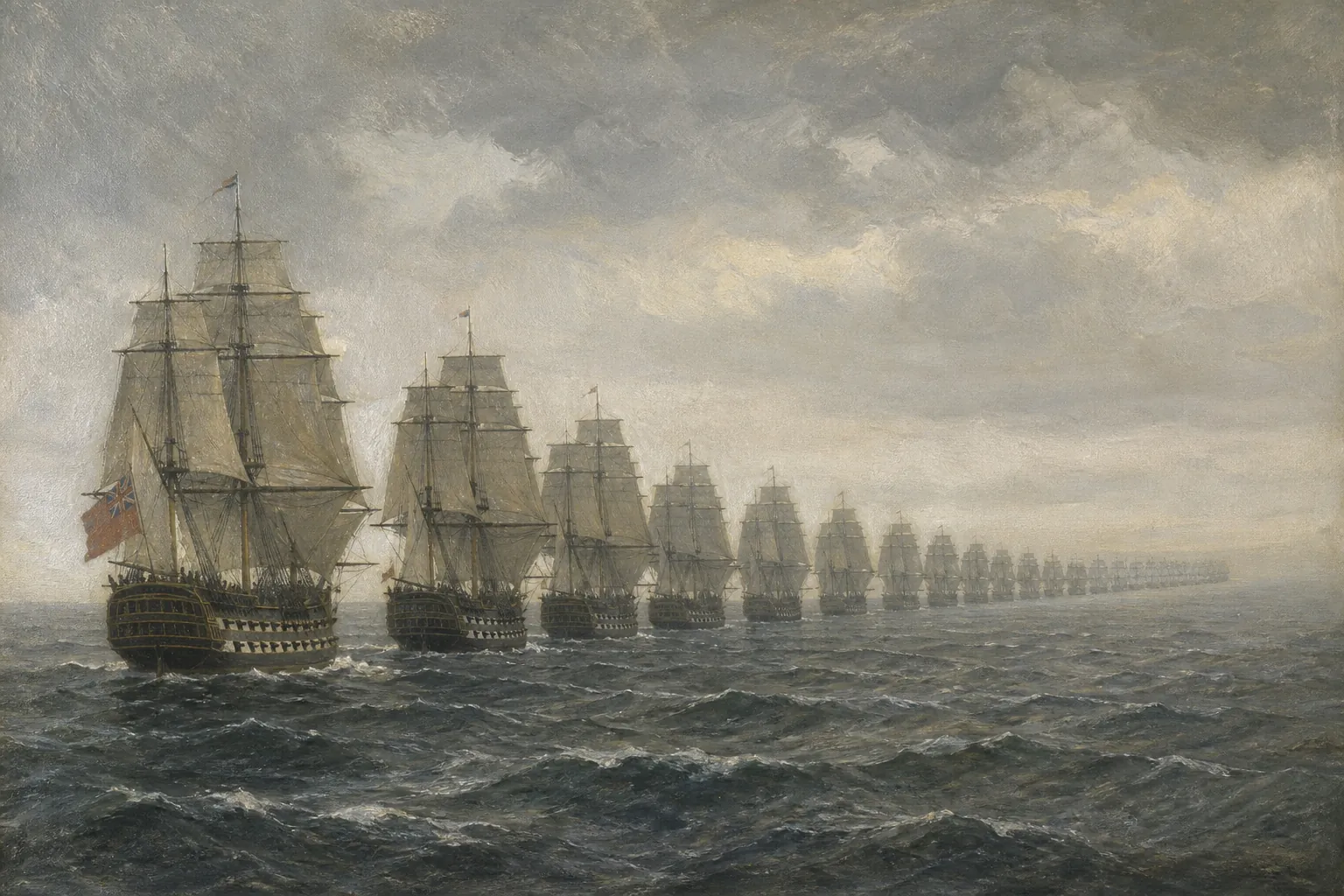 Generated illustration. Not a historical photograph. Ships of the line in a single fighting line.
Claim
Age of Sail — Era Overview already treats the line of battle as the era’s dominant fleet tactic: ships formed a single line to bring maximum broadside firepower to bear, from the 1650s until Nelson Horatio — Biography Overview broke the enemy line at the Battle of Trafalgar 1805 — Overview.1
In This Vault
Two filled battles show the rule and the break.
At the Battle of Cape St Vincent 1797 — Overview, Jervis John Earl St Vincent — Biography fought in line. Nelson, in HMS Captain — 74-gun Third Rate and second from the rear, wore out of that line about 1:30 pm without orders and threw Captain across the Spanish van, including Santísima Trinidad — Spanish First Rate. Jervis let the wear stand. Knight pp. 211–230 is the licensed spine for that day.2
At Trafalgar Nelson attacked perpendicular to the Combined line in two columns — weather column in HMS Victory — Overview, lee column under Collingwood Cuthbert — Biography in HMS Royal Sovereign — Overview — instead of forming a parallel line. The battle overview already calls that approach unprecedented.3
Limits
This note does not write a history of Fighting Instructions, date the first formal line, or fill The Nelson Touch — Breaking the Line at Trafalgar. Those remain roadmap items under Tactics_Doctrine_Index. The 1650s opening date is the era note’s date, not a new page.
Sources
- Age of Sail — Era Overview — already sourced to @white2005nelson
- @knight2005pursuit — pp. 211–230 (Cape St Vincent wear)
- @adkin2005trafalgar — 1805 two-column action, pp. 286–323 already used
- Battle of Cape St Vincent 1797 — Overview
- Battle of Trafalgar 1805 — Overview
Related
Navigation
- MOC_Military_Forces
- Tactics_Doctrine_Index — first primary note in an empty tactics room
Battles That Use It
- Battle of Cape St Vincent 1797 — Overview — Nelson left the line
- Battle of Trafalgar 1805 — Overview — two columns through the Combined line
- Trafalgar Campaign 1805
Ships / People
- HMS Captain — 74-gun Third Rate
- HMS Victory — Overview
- Santísima Trinidad — Spanish First Rate
- Jervis John Earl St Vincent — Biography
- Nelson Horatio — Biography Overview
- Collingwood Cuthbert — Biography
Cross-Domain
- Age of Sail — Era Overview
- Royal Navy — Institutional Overview
- First Rate Ship of the Line — Class Overview
Footnotes
-
Doctrine sentence is already on Age of Sail — Era Overview (White). This note does not add a new century of origins. ↩
-
Wear, 1:30 pm, Captain, Spanish van: Battle of Cape St Vincent 1797 — Overview and Jervis John Earl St Vincent — Biography, Knight pp. 211–230. ↩
-
Two-column attack: Battle of Trafalgar 1805 — Overview (White). ↩