Tactics Doctrine Index
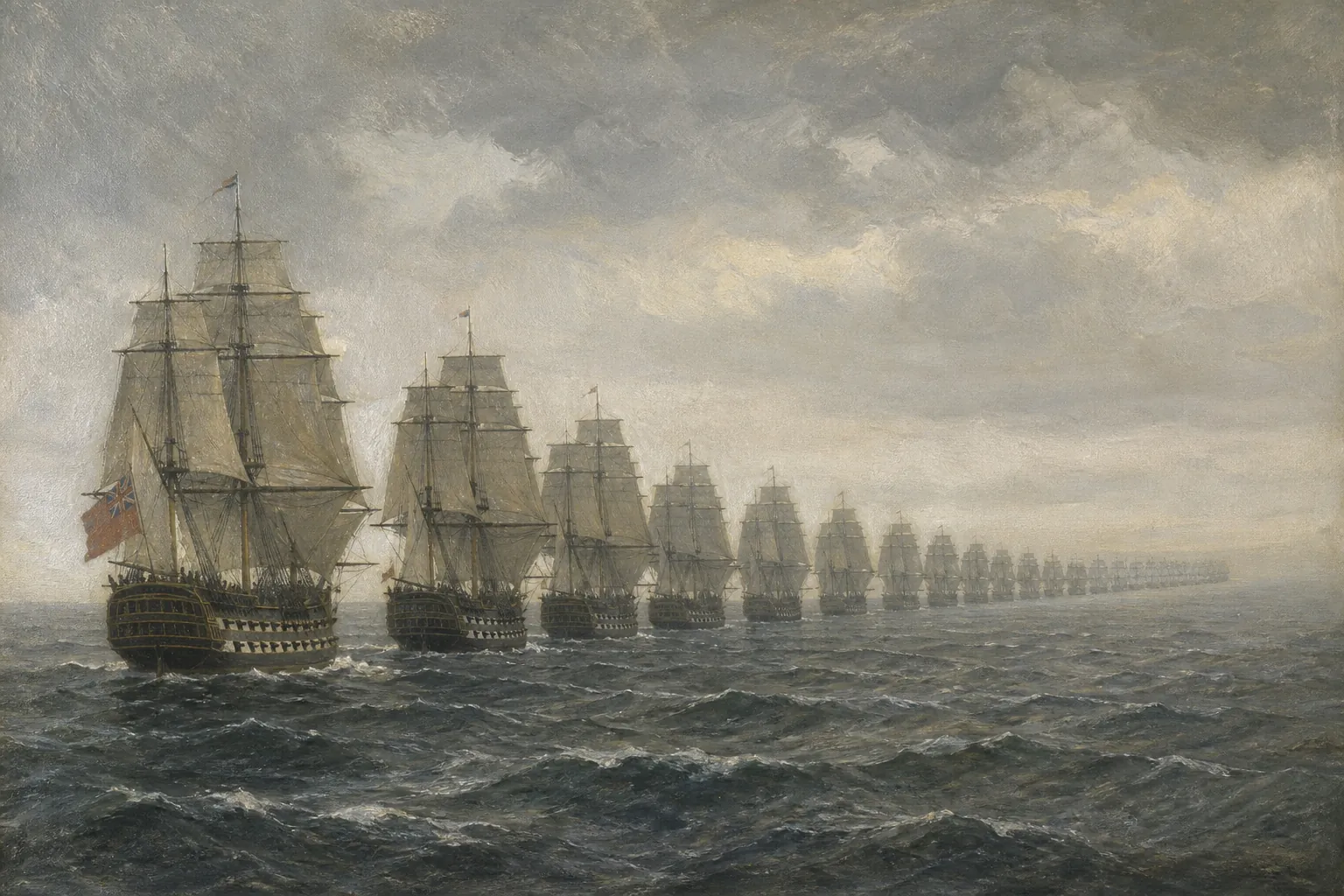 Generated illustration. Not a historical photograph. Ships of the line in line-ahead.
Hub
Tactics and doctrine — how commanders were taught to fight, what manoeuvres they were trained to execute, and the unwritten conventions that governed their decisions in battle — are the connective tissue between military institutions and military outcomes. The subdomain covers the long evolution across every era: the chariot warfare of the late Bronze Age; the Greek hoplite phalanx and Macedonian sarissa; the Roman manipular legion and its cohort successor; the Byzantine combined-arms doctrine codified in the Strategikon and Taktika; medieval feudal heavy cavalry and the Welsh longbow revolution; the Renaissance pike-and-shot synthesis and Maurice of Nassau’s drill reforms; Gustavus Adolphus’s tactical innovations and the Swedish system; the line-and-column debates of the eighteenth century at sea and on land (Pavillon, Howe, Saint-Hilaire, Frederick the Great’s oblique order); the dramatic Napoleonic transformation in combined arms and the Trafalgar-era line-of-battle revolution; the late-nineteenth-century crisis of mass-conscript armies and breech-loading weapons; the trench-and-stormtroop adaptations of the First World War; the combined-arms blitzkrieg and Soviet operational art of the Second; deep-battle Cold War doctrine; and the contemporary doctrines of counter-insurgency, network-centric warfare, and the cyber-electromagnetic domains. The Nelson Touch and the related British and French line tactics that the current vault focus visits are one celebrated chapter in this longer story. Adjacent to MOC_Conflicts (application), MOC_Military_Forces (institutions and ranks), and MOC_Communications_Signals (signal systems that enable doctrine).
Primary Notes
- Line of Battle — Naval Tactic — first filled tactics note; Age of Sail fighting line
- Nelson’s Patent Bridge for Boarding First Rates — officers’ name for the 14 February 1797 boarding
- Nelson’s Touch — Command Philosophy — pre-battle briefing so captains could act without orders
Roadmap
(planned notes as red-links — add as research identifies gaps)
Methodology
- Military Doctrine — Definition, Sources, and Cross-Era Method
- Battlefield Friction — Clausewitz and the Persistent Constraints
Ancient and Classical
- Bronze-Age Chariot Warfare — Egypt, Hittites, and the Late-Bronze System
- The Greek Hoplite Phalanx — Origins, Use, and Limits
- The Macedonian Sarissa Phalanx — Philip and Alexander’s Revolution
- The Roman Manipular Legion and Its Cohort Successor
- Byzantine Combined Arms — Strategikon and Taktika
Medieval
- Feudal Heavy Cavalry — Charge, Lance, and the Mounted Aristocracy
- Welsh Longbow and the English Tactical System 1300–1450
- Steppe Light Cavalry — Mongol and Turkic Operational Doctrine
Early Modern
- Pike and Shot — The Sixteenth-Century Tactical Synthesis
- Maurice of Nassau and Dutch Drill — The Military Revolution
- Gustavus Adolphus and the Swedish Tactical System
- Frederick the Great’s Oblique Order — Prussian Tactical Doctrine
Age of Sail (current vault focus)
- Line of Battle — Naval Tactic — now filled (see Primary Notes)
- The Nelson Touch — Breaking the Line at Trafalgar
- Popham’s Signal Code — Communication in Battle
- Napoleonic Column vs Line — Tactical Debate
- Light Infantry and Skirmisher Doctrine 1800–1815
Industrial Age (1815–1914)
- The Late-Nineteenth-Century Tactical Crisis — Breech-Loaders, Magazines, and Smokeless Powder
- Naval Tactics in the Steam Age — Line-Abreast, the Ram, and the Pre-Dreadnought Battle Fleet
- The Plan XVII and Schlieffen-Era Doctrine on the Eve of 1914
Twentieth Century
- The First World War — Trench Stalemate to Storm-Troop and Combined-Arms Solutions
- Blitzkrieg and German Combined-Arms Doctrine 1939–1941
- Soviet Deep Battle and Operational Art
- Carrier Doctrine in the Second World War — US, Japanese, and Royal Navy Approaches
- Cold War Operational Doctrine — Active Defence, AirLand Battle, and Soviet Counterparts
Contemporary
- Counter-Insurgency Doctrine — From Algeria and Vietnam to the Post-2001 Wars
- Network-Centric Warfare and the Information Age
- Cyber and Electromagnetic Domains — Emerging Doctrine in the 2020s
Cross-Cutting
- See also: MOC_Military_Forces
- See also: _Home