Villeneuve Pierre-Charles — French Admiral
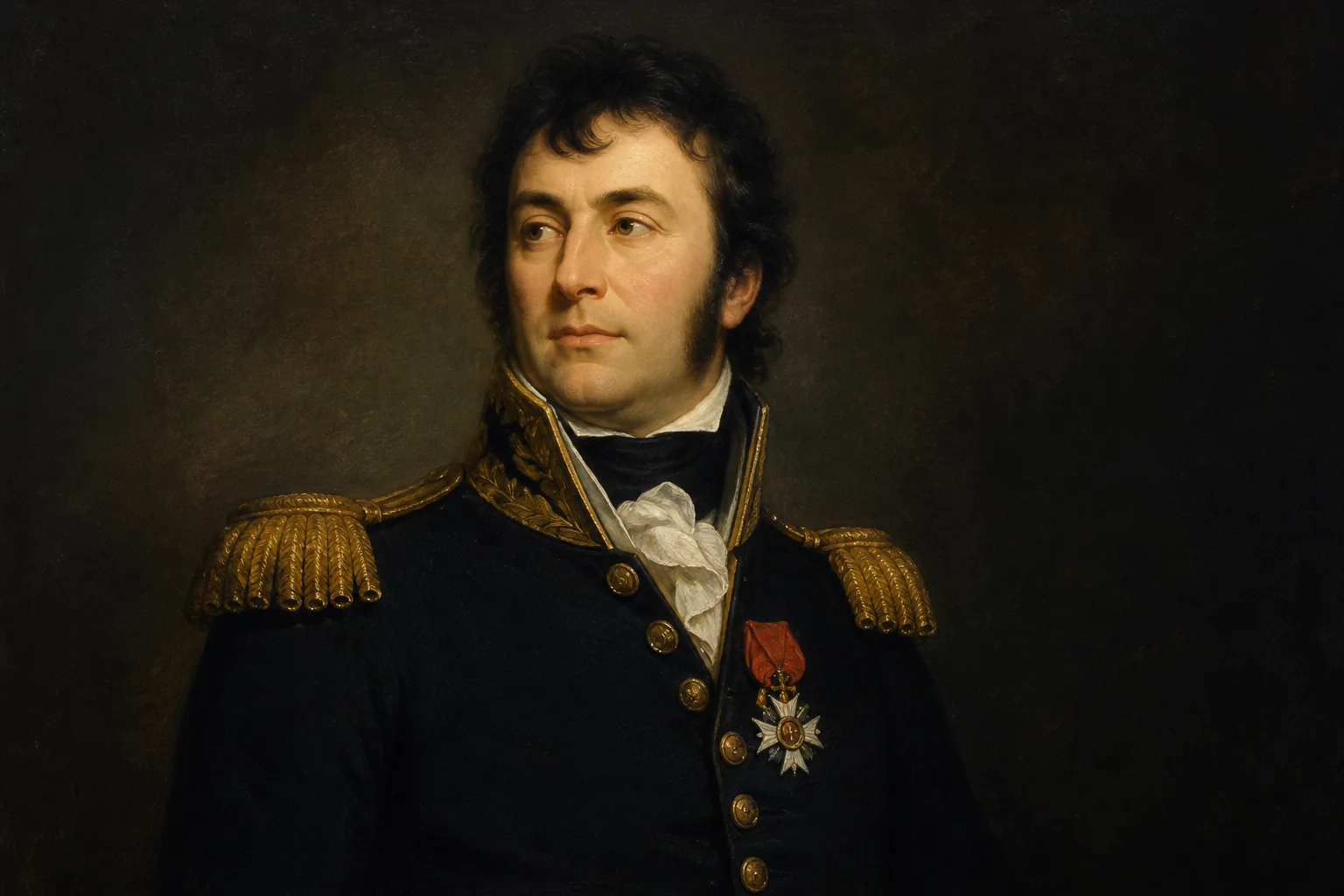 Generated portrait. Not a historical photograph.
Overview
Pierre-Charles Villeneuve (1763–1806) was a French vice-admiral born to Provençal nobility who commanded the Franco-Spanish Combined Fleet defeated by Nelson Horatio — Biography Overview at the Battle of Trafalgar 1805 — Overview. He had survived the Battle of the Nile 1798 — Overview only to lose his fleet, his flagship Bucentaure — Overview, and his career seven years later. His death by stabbing at Rennes in April 1806 — officially suicide, popularly suspected as Napoleonic murder — remains contested.
Early Life
Born 31 December 1763 at Valensole in Provence, Villeneuve entered the Royal French Navy as a garde de la marine in 1778 at age fifteen. He served as ensign aboard Marseillois in de Grasse’s American war fleet and later under Suffren in the Indian Ocean campaigns of 1782–83. His aristocratic origin nearly destroyed him during the Revolution: dismissed in the purges, he dropped the nobiliary “de” from his name and was reinstated in May 1795.
Career and Key Roles
He rose quickly under the Directory and Consulate — capitaine de vaisseau February 1793, rear-admiral September 1796, vice-admiral May 1804. At the Battle of the Nile 1798 — Overview he commanded the rear division aboard the 80-gun Guillaume Tell; the British van rolled up the French line before he could engage, and at dawn on 2 August he cut his cables and escaped with three other ships — the only French ships of the line to survive. In August 1804, on the death of Latouche-Tréville Louis-René — French Admiral, Napoleon gave him the Toulon fleet.
Key Decisions and Actions
The 1805 campaign was Napoleon’s plan and Villeneuve’s catastrophe. Sailing from Toulon on 29 March 1805 he passed the Strait of Gibraltar — Strategic Waterway, joined Gravina Federico — Spanish Admiral at Cadiz — Spanish Naval Port, and crossed to Martinique to draw Nelson Horatio — Biography Overview west. He recrossed the Atlantic, fought the inconclusive Battle of Cape Finisterre 1805 against Calder on 22 July, then — finding the wind in his favour the next day — declined to renew action and retreated to Cadiz. On 18 October, learning that Rosily-Mesros François-Étienne — French Admiral was at Madrid with orders to relieve him, he sortied to fight before he could be replaced.
At the Battle of Trafalgar 1805 — Overview on 21 October 1805 his flagship Bucentaure — Overview was dismasted in roughly three hours of close action. Villeneuve, reportedly the only officer aboard not wounded, surrendered to a boarding party from HMS Conqueror and was carried to England a prisoner of war.
Personal Life
Villeneuve was held on parole at Bishop’s Waltham in Hampshire. Captain Fremantle described him as “a very pleasant and gentlemanlike man.” Whether he attended Nelson’s state funeral on 9 January 1806 is contested in modern scholarship; no contemporary press reference has been located.1 He was repatriated to Morlaix on 18 April 1806 in exchange for four British captains.
Legacy
Four days after returning to French soil, Villeneuve was found dead in his room at the Hôtel de la Patrie in Rennes — six dagger wounds in his chest, a suicide note to his wife.2 Napoleon ordered the letter suppressed and forbade discussion. The official verdict was suicide; British contemporaries scoffed; suspicion of Napoleonic assassination has persisted ever since.3 No autopsy survives, the police report has vanished, and his grave is unknown. His name was nevertheless inscribed on the Arc de Triomphe. Modern French naval historians treat him as a competent officer crushed by impossible orders and Napoleon’s contempt — the Emperor’s own verdict was that “Villeneuve is one of those men who have need of the spur rather than the bridle.”
Sources
Related
Navigation
Same Subject — Combined Fleet Command
- Gravina Federico — Spanish Admiral
- Latouche-Tréville Louis-René — French Admiral
- Rosily-Mesros François-Étienne — French Admiral
- Decrès Denis — French Naval Minister
Key Battles
- Battle of Trafalgar 1805 — Overview
- Battle of the Nile 1798 — Overview
- Battle of Cape Finisterre 1805
Key Ships
- Bucentaure — Overview — his flagship at Trafalgar
- Redoutable — French 74-gun Ship
- Santísima Trinidad — Spanish First Rate
Cross-Domain
- Cadiz — Spanish Naval Port
- Cape Trafalgar — Geography
- Royal Navy — Institutional Overview
- Napoleonic Wars — Overview
Footnotes
-
Society for Nautical Research forum debate; the Hampshire Telegraph and other contemporary press make no contemporary mention. Treat as
status/contested. ↩ -
Wound count varies in the literature: five (left lung) plus one (heart), or six in the chest, or seven across all sources; “six wounds” is the dominant secondary-tradition shorthand. ↩
-
Adkins, Trafalgar (2005), p. 323; Oxford Reference; modern reassessments name René Savary or Joseph Fouché as plausible candidates if murder did occur. No definitive evidence has ever been produced. ↩