Baltic Naval Stores — 1800–1801
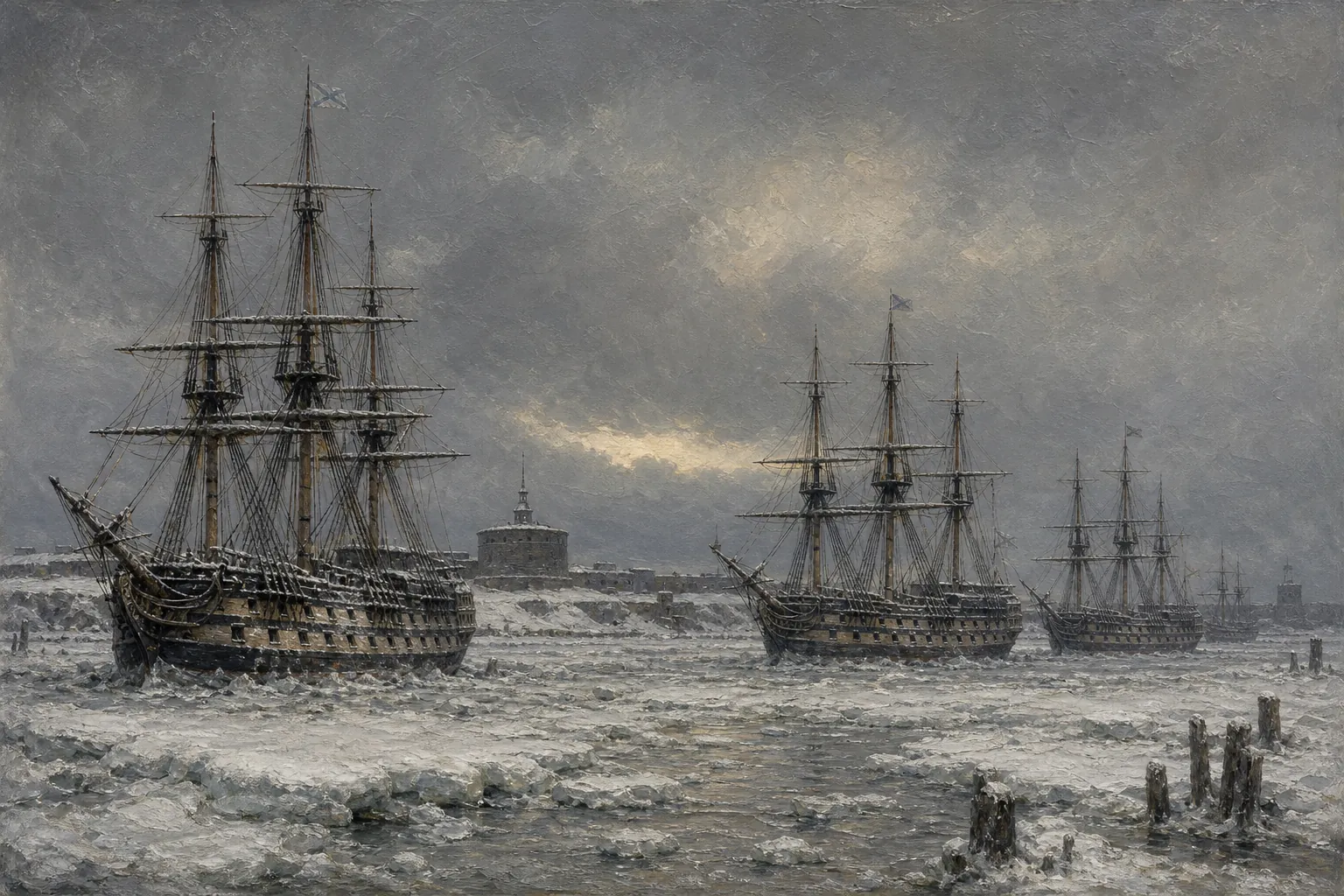 Generated illustration. Not a historical photograph. Ships in Baltic ice. Not a portrait.
Overview
The Battle of Copenhagen 1801 — Overview already says Britain depended on Baltic timber, hemp, tar, and pitch. The League of Armed Neutrality of the North 1800–1801 threatened to close that sea to British trade.1
The Crisis
This note covers that supply crisis only. Sound dues, later grain trades, and the 1807 bombardment stay on RESEARCH_QUEUE. Sea_Lanes_Straits stays empty.
The Pitt and Addington governments sent a Baltic fleet to break the league before Russian and Swedish ships could escape the spring ice. After the 2 April 1801 battle and the 9 April armistice, the Baltic reopened to British naval stores.2
Sources
- @knight2005pursuit — pp. 374–408
- @white2005nelson
- @adkin2005trafalgar
- Battle of Copenhagen 1801 — Overview
- League of Armed Neutrality of the North 1800–1801
Related
Navigation
- MOC_Economics_Commerce
- Trade_Routes_Index — first primary note in an empty trade-routes room
Same Campaign
- Battle of Copenhagen 1801 — Overview
- League of Armed Neutrality of the North 1800–1801
- Copenhagen — Denmark
- Hyde Parker — British Admiral
- King’s Deep Soundings — Copenhagen 1 April 1801
Cross-Domain
Footnotes
-
Timber, hemp, tar, pitch; close the Baltic: Battle of Copenhagen 1801 — Overview and the league note. ↩
-
Ice; 2 April; armistice 9 April; Baltic reopened: same battle note. Do not add Sound dues or 1807 until a page is licensed. ↩