HMS Elephant — 74-gun Third Rate
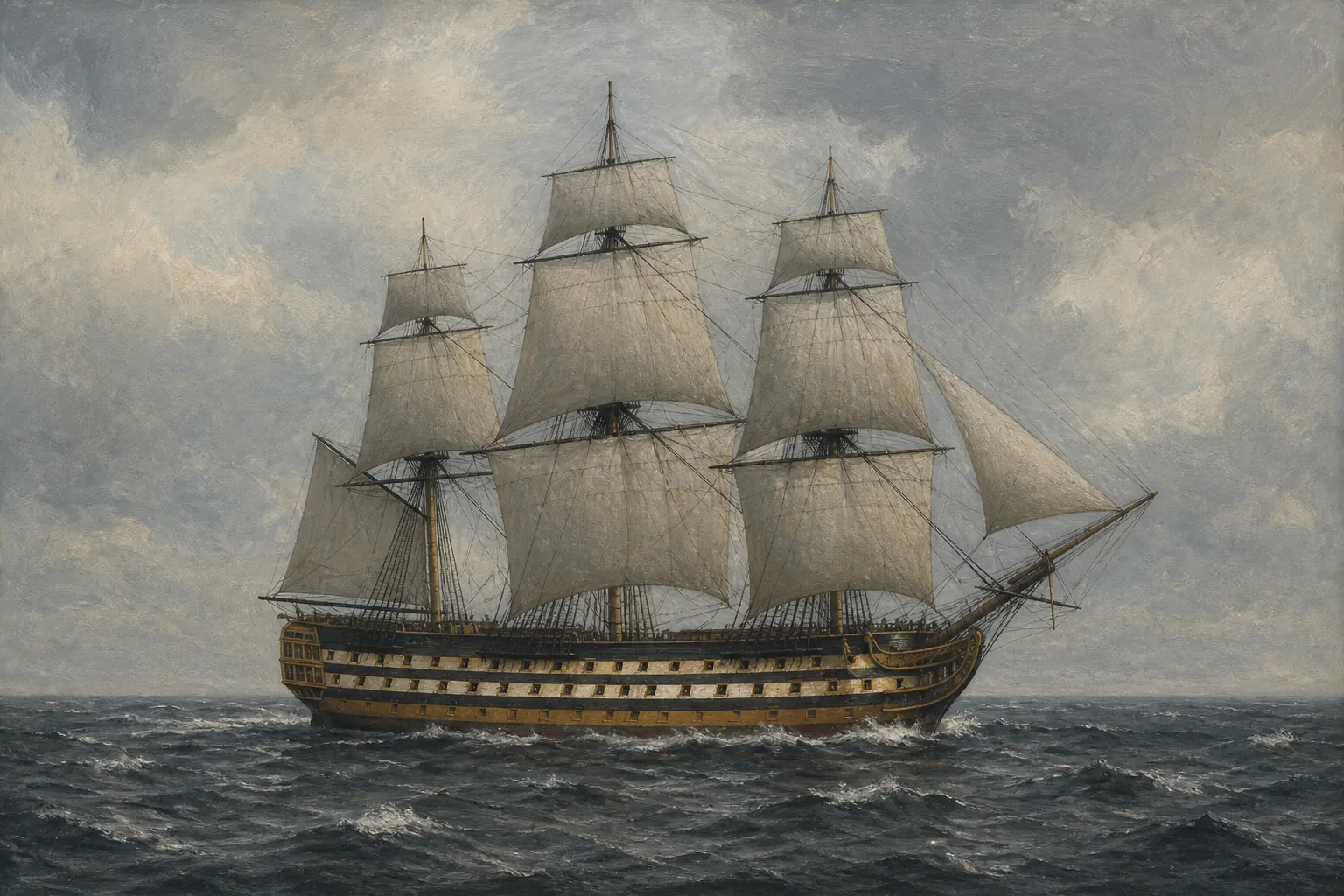 Generated illustration. Not a historical photograph. A British 74-gun two-decker of the Copenhagen generation. Not a named portrait of the ship.
Overview
Elephant was the British 74-gun two-decker Nelson Horatio — Biography Overview used as his inshore flag at the Battle of Copenhagen 1801 — Overview on 2 April 1801. The battle overview already says he transferred from HMS St George — 98-gun Second Rate because that ship was too deep for the King’s Deep channel, and that Captain Thomas Foley had Elephant.1
Specifications
| Feature | Detail |
|---|---|
| Guns | 74 |
| Type | British two-decker ship of the line |
| Fleet | Parker’s Baltic fleet, inshore squadron 2 April 1801 |
A 74 is the same rate-family as HMS Captain — 74-gun Third Rate, not a First Rate Ship of the Line — Class Overview.
Service
This note covers 2 April 1801 only. Launch yard, earlier commissions, and later fate stay on RESEARCH_QUEUE.
Hardy Thomas Masterman — Captain HMS Victory in St George had sounded the channel overnight on 1 April. At dawn Nelson took twelve ships into the King’s Deep from Elephant. Three ships — Bellona, Russell, and Agamemnon — ran aground, leaving nine. Around 1pm Hyde Parker — British Admiral hoisted Signal 39 from HMS London; Nelson, on Elephant, kept Signal 16 flying. The truce letter went ashore later that afternoon.2
Sources
- @knight2005pursuit — pp. 374–408
- @white2005nelson
- @adkin2005trafalgar
- Battle of Copenhagen 1801 — Overview
Related
Navigation
Same Battle
- Battle of Copenhagen 1801 — Overview
- Hyde Parker — British Admiral
- King’s Deep Soundings — Copenhagen 1 April 1801 — why Elephant could enter at dawn
- Copenhagen — Denmark
- HMS Captain — 74-gun Third Rate — earlier Nelson 74
- L’Orient — French 120-gun Flagship — earlier flagship destruction, different battle
Cross-Domain
Footnotes
-
Transfer, draught, Foley: Battle of Copenhagen 1801 — Overview. ↩
-
Soundings, grounding, signals: same battle note. Do not add a launch year until a page is licensed. ↩