Battle of Copenhagen 1801 — Overview
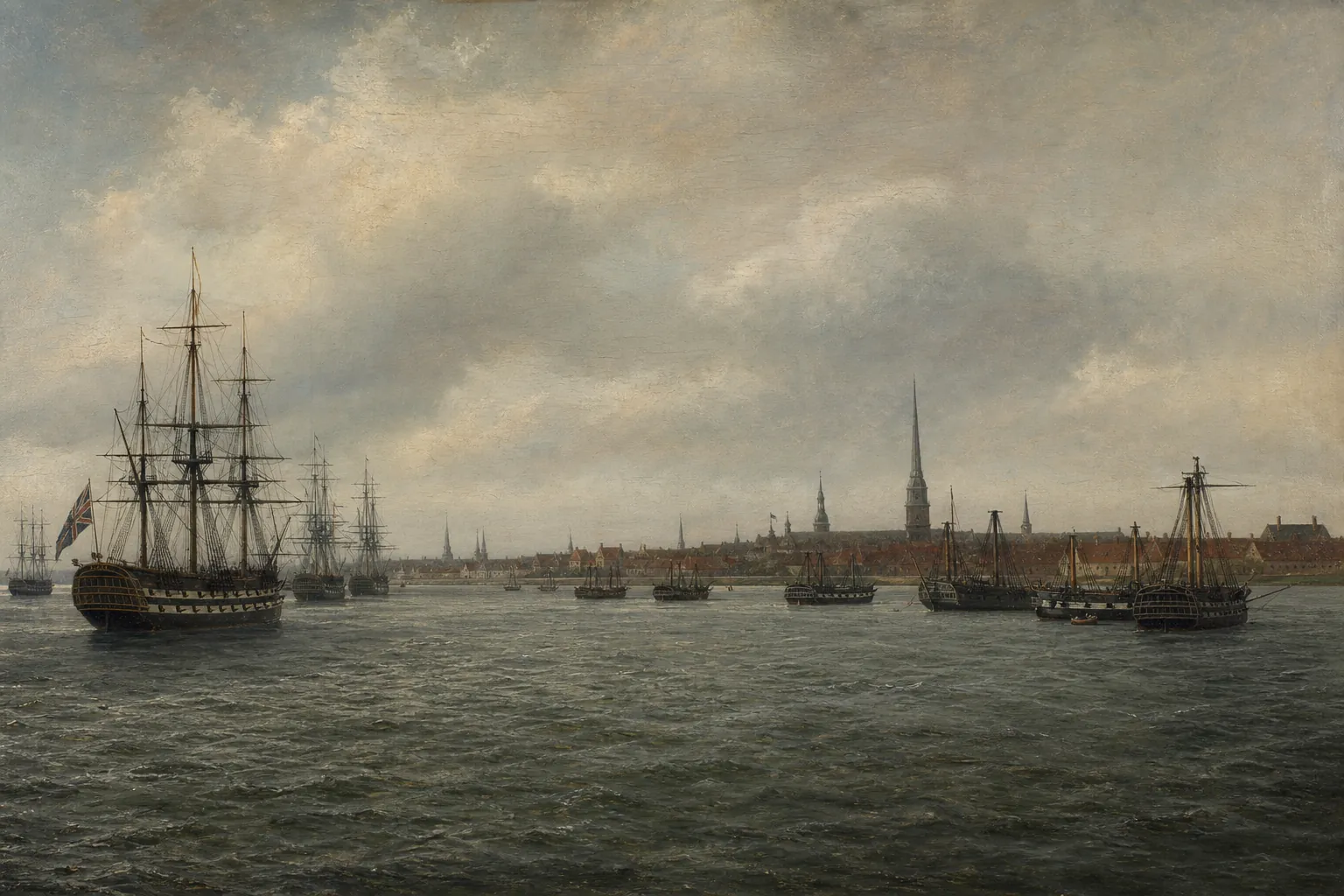 Generated illustration. Not a historical photograph. An anchorage off a northern capital. Not a likeness.
Overview
On 2 April 1801, Nelson — second-in-command to Admiral Sir Hyde Parker — led an inshore squadron through the King’s Deep channel to attack the Danish defensive line off Copenhagen. Four hours of close-range gunnery destroyed the Danish line; Nelson famously raised a telescope to his blind eye when Parker hoisted the recall signal. He then sent ashore under flag of truce a personal letter to the Danish Crown Prince offering humanitarian terms — accepted, leading to an armistice that broke the Armed Neutrality of the North.
Background and Causes
The Second League of Armed Neutrality (Denmark, Sweden, Russia, Prussia), formed December 1800 by Tsar Paul I, asserted neutral shipping rights against Royal Navy stop-and-search and threatened to close the Baltic to British trade. For Britain this meant losing the timber, hemp, tar, and pitch supply on which the Royal Navy depended. The Pitt and Addington governments dispatched a Baltic fleet to break the league before Russian and Swedish ships could escape the spring ice and combine with the Danes.
Forces Involved
British (Parker): 18 ships of the line plus frigates and bomb vessels. Flagship HMS London (Parker, kept distant). Nelson transferred his flag from HMS St George — 98-gun Second Rate (too deep for the inshore channel) to HMS Elephant — 74-gun Third Rate under Captain Thomas Foley. Hardy in St George conducted the crucial overnight soundings of the channel on 1 April.
Danish (Fischer): not a sea-going fleet but a static defensive line — 18 hulks, blockships, and floating batteries anchored bow-to-stern off the city, supplemented by Trekroner Fort — Copenhagen (~70 guns) and other shore batteries.
Course of Events
At dawn on 2 April Nelson’s twelve ships approached the King’s Deep. HMS Bellona (74), HMS Russell (74), and Nelson’s old Agamemnon (64) all ran aground entering the channel — possibly because the Danes had moved the channel buoys — reducing his effective force from twelve to nine.
Action opened around 10am at close range, ship versus blockship; the Danish line was progressively battered into silence over four hours of gunnery. Around 1pm Parker, three miles distant in London, hoisted Signal No. 39 — discontinue the action — as a permissive order. Nelson turned to Foley and Lieutenant-Colonel William Stewart, said he had “only one eye, I have a right to be blind sometimes,” put his telescope to his blind right eye, and declared he could not see the signal. He kept his own Signal 16 — engage the enemy more closely — flying.1
By 2pm, with the Danish line largely silenced but Trekroner still firing, Nelson sent ashore a flag of truce with a personal letter “to the Brothers of Englishmen, the Danes,” offering humanitarian terms. Crown Prince Frederik accepted; firing died away.
Outcome and Casualties
British: 254 killed, 689 wounded. No ships lost.
Danish: approximately 700 killed, 900 wounded, around 1,700 prisoners. About twelve Danish ships destroyed, captured, or rendered unusable; one prize, Holsteen (60), was taken into the Royal Navy as HMS Holstein.
Strategic Consequences
The Armed Neutrality collapsed within weeks. Tsar Paul I had been assassinated ten days earlier (news not yet reached either fleet); Alexander I withdrew, Sweden followed, the Danish armistice signed 9 April. The Baltic reopened to British naval stores. Nelson was created Viscount Nelson of the Nile; Parker was recalled and never held active command again. Hardy’s soundings cemented a Nelson-Hardy bond that would later place him on Victory’s quarterdeck at Trafalgar.
Sources
Related
Navigation
Same Campaign — Nelson’s Three Pre-Trafalgar Battles
- Battle of Cape St Vincent 1797 — Overview
- Battle of the Nile 1798 — Overview
- Battle of Trafalgar 1805 — Overview
Key People
- Nelson Horatio — Biography Overview
- Hardy Thomas Masterman — Captain HMS Victory
- Hyde Parker — British Admiral
- Fischer Olfert — Danish Commodore
- Stewart William — Lt-Col
- Crown Prince Frederik — Denmark
- Tsar Paul I of Russia
- Tsar Alexander I of Russia
Ships Involved
- HMS Elephant — 74-gun Third Rate
- HMS St George — 98-gun Second Rate
- HMS Agamemnon — 64-gun Third Rate
- HMS Bellona — 74-gun Third Rate — grounding only, 2 April 1801
- HMS Russell — 74-gun Third Rate — grounding only, 2 April 1801
- HMS London — Parker Distant Flagship — posting / distance only; no rate
Cross-Domain
- Copenhagen — Denmark
- League of Armed Neutrality of the North 1800–1801
- Baltic Naval Stores — 1800–1801
- Trekroner Fort — Copenhagen
- King’s Deep Soundings — Copenhagen 1 April 1801 — Hardy, night of 1 April
- Royal Navy — Institutional Overview
- Age of Sail — Era Overview
- Copenhagen Good Friday — 953 — Good Friday / 953 only
Footnotes
-
The exact wording of Nelson’s “blind eye” speech varies across primary sources (Stewart’s Cumloden Papers, Foley’s later recollections). The episode is well-attested but the canonical phrasing is a literary smoothing — see Q — Did Nelson really say “blind eye” at Copenhagen. ↩