Battle of Cape St Vincent 1797 — Overview
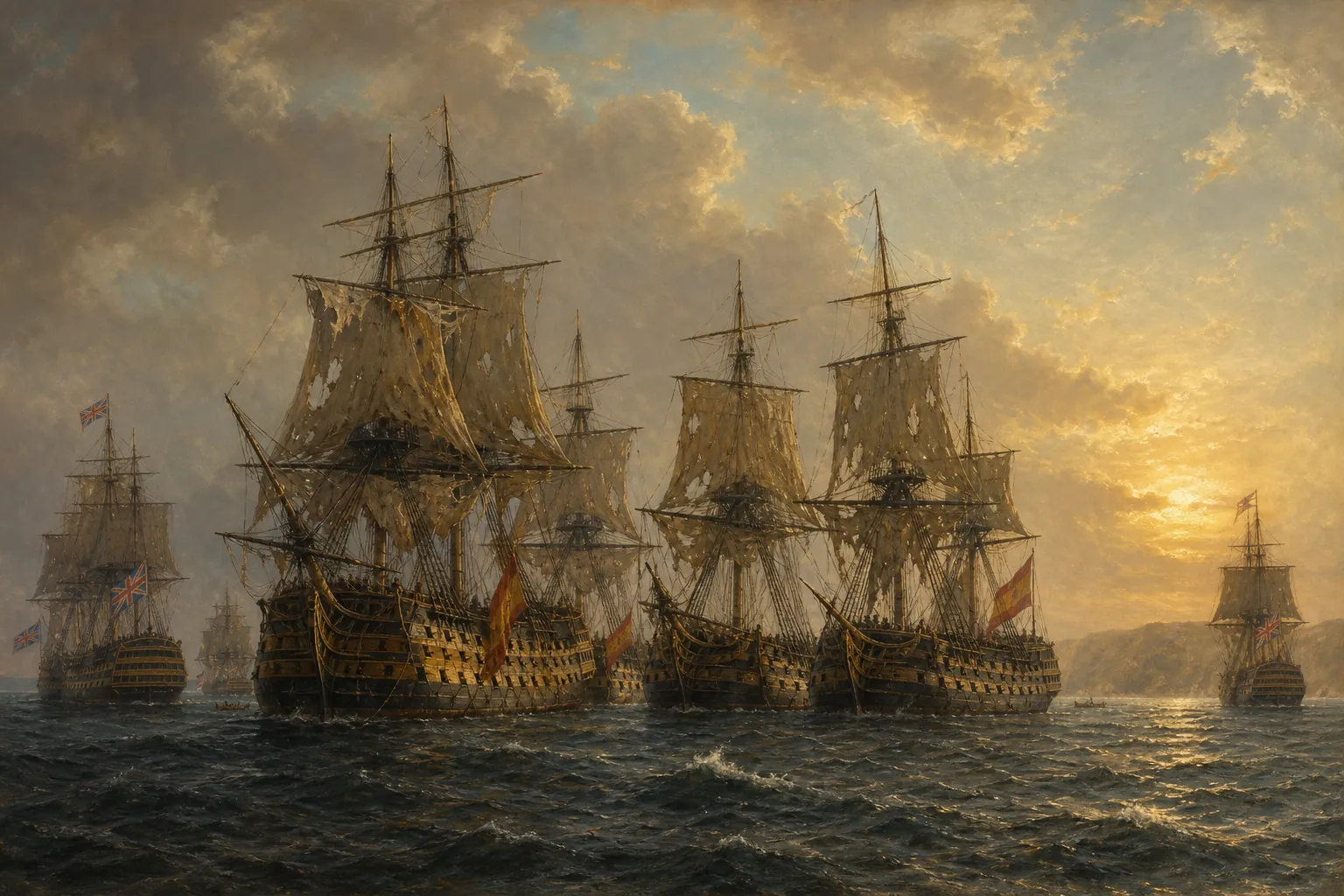 Generated illustration. Not a historical photograph. The four Spanish prizes of 14 February 1797. Not an order of battle.
Overview
On St Valentine’s Day 1797, Admiral Sir John Jervis in HMS Victory — Overview led 15 British ships of the line against a Spanish fleet of 27 under Don José de Córdova off the south-western tip of Portugal. The British drove between the two badly separated Spanish divisions; Commodore Nelson in HMS Captain wore out of the line of battle without orders, threw his ship across the bows of the Spanish van, and personally led boarding parties that captured two Spanish ships in succession — “Nelson’s Patent Bridge for Boarding First Rates.” Four Spanish ships of the line were taken; the rest fled to Cadiz — Spanish Naval Port.
Background and Causes
Spain joined France against Britain in October 1796 under the second Treaty of San Ildefonso. The British Mediterranean fleet was forced out: Corsica was evacuated November 1796 and Jervis withdrew to the Tagus. Córdova sailed from Cartagena on 1 February 1797 with orders to escort a mercury convoy to Cadiz, then rendezvous with the French Brest fleet for the planned invasion of Britain.
Forces Involved
British (Jervis): 15 ships of the line. Flagship HMS Victory — Overview with Calder as Captain of the Fleet. Nelson in HMS Captain — 74-gun Third Rate, Collingwood in HMS Excellent — 74-gun Third Rate, Troubridge in HMS Culloden leading the line.
Spanish (Córdova): 27 ships of the line including Santísima Trinidad — Spanish First Rate (130 guns, the only four-decker in the world), six 112s, eighteen 74s, plus 12 frigates. Crews short of trained seamen, padded with soldiers and pressed landsmen.
Course of Events
Squally weather had separated the Spanish into two divisions — 18 in the lee group, 9 to windward. Jervis signalled at 11am to drive between them; the British line tacked in succession through the gap to engage the larger lee division.
About 1:30pm Nelson, second from the rear, saw the Spanish van wearing north to rejoin the convoy guard. Without waiting for the ships ahead to tack, he wore Captain out of the line and threw her across the bows of Santísima Trinidad and four other ships. Captain was heavily mauled but held the Spanish van until Collingwood in Excellent arrived to relieve him — forcing the strikings of Salvador del Mundo (112) and San Ysidro (74) in succession.
When San Nicolás (84) and San José (112) collided and became entangled, Nelson ran Captain alongside San Nicolás; Berry led the boarding party through her stern gallery and her captain struck. With San José still entangled, Nelson led the same party across San Nicolás’s deck onto San José and received the surrender of her officers — the manoeuvre Nelson’s officers christened “Nelson’s Patent Bridge for Boarding First Rates.”
Outcome and Casualties
British: 73 killed, 327 wounded. No ships lost.
Spanish: approximately 261 killed, 342 wounded, around 3,000 prisoners. Four ships of the line captured: San José (112), Salvador del Mundo (112), San Nicolás (84), and San Ysidro (74). The remaining Spanish fleet escaped to Cadiz, where it would be blockaded for two years.
Strategic Consequences
The planned Franco-Spanish junction at Brest was prevented and the invasion threat to Britain collapsed. Jervis was created Earl of St Vincent; Nelson was promoted Rear-Admiral and made Knight of the Bath, choosing the KB over a baronetcy for the visible star. Cape St Vincent made Nelson’s reputation and led directly to his return to the Mediterranean and the Battle of the Nile 1798 — Overview eighteen months later.
Sources
Related
Navigation
Same Campaign — Nelson’s Three Pre-Trafalgar Battles
- Battle of the Nile 1798 — Overview
- Battle of Copenhagen 1801 — Overview
- Battle of Trafalgar 1805 — Overview
Key People
- Nelson Horatio — Biography Overview
- Jervis John Earl St Vincent — Biography
- Collingwood Cuthbert — Biography
- Calder Robert — British Admiral
- Berry Edward — British Captain
- Troubridge Thomas — British Captain
- Córdova José de — Spanish Admiral
Ships Involved
- HMS Victory — Overview
- HMS Captain — 74-gun Third Rate
- HMS Excellent — 74-gun Third Rate
- Santísima Trinidad — Spanish First Rate
- San José — Spanish 112-gun First Rate
- San Nicolás — Spanish 84-gun Third Rate
- Salvador del Mundo — Spanish 112-gun First Rate
- San Ysidro — Spanish 74-gun Third Rate
Cross-Domain
- Cadiz — Spanish Naval Port
- Royal Navy — Institutional Overview
- Age of Sail — Era Overview
- Line of Battle — Naval Tactic — the formation Nelson left
- Nelson’s Patent Bridge for Boarding First Rates
- Four Spanish Prizes of Cape St Vincent 1797
- Treaty of San Ildefonso 1796
- Mercury Convoy — Córdova 1 February 1797 — convoy / 1 February / mercury only
- Troubridge Thomas — British Captain