Hardy Thomas Masterman — Captain HMS Victory
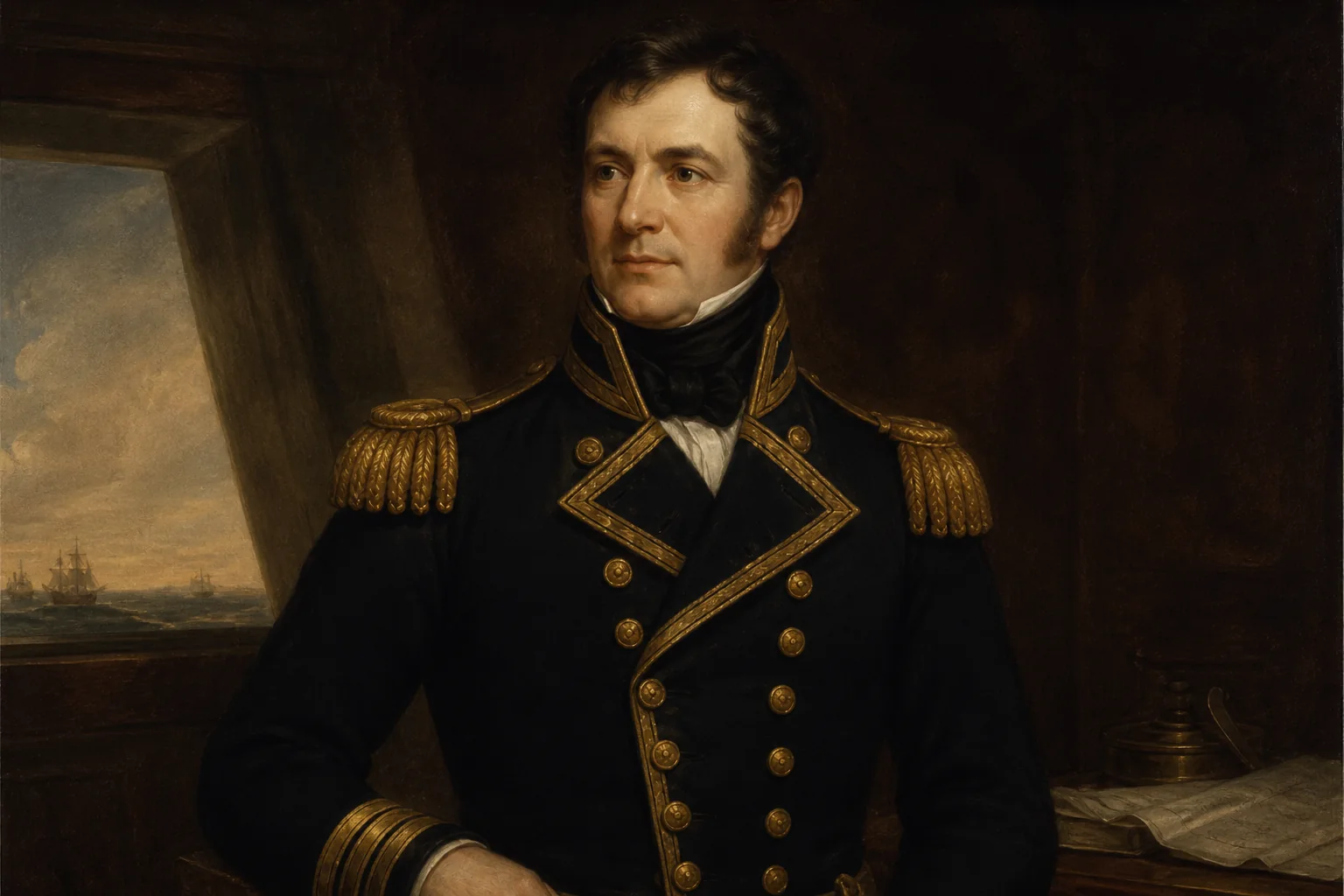 Generated portrait. Not a historical photograph.
Overview
Sir Thomas Masterman Hardy, 1st Baronet (1769–1839) was Nelson’s closest professional companion — flag captain at the Battle of the Nile 1798 — Overview, at Battle of Copenhagen 1801 — Overview, and at the Battle of Trafalgar 1805 — Overview aboard HMS Victory — Overview. He was on the quarterdeck when Nelson was shot, knelt beside him in the cockpit, and received his last words. He served afterwards as Commodore on the South America Station, First Naval Lord under Earl Grey, and Governor of Greenwich Hospital.
Early Life
Born 5 April 1769 at Kingston Russell House, Dorset, second son of Joseph Hardy of Portisham and Anne Masterman. He attended Crewkerne Grammar School c. 1782–85 while his name was nominally carried on HMS Seaford and HMS Carnatic. He entered the Navy as captain’s servant aboard the brig HMS Helena in November 1781, aged twelve.
Career and Key Roles
Commissioned second lieutenant in HMS Meleager in November 1793 — fighting at Genoa and the Hyères Islands (1795) — Hardy followed Captain George Cockburn to HMS Minerve — Frigate in August 1796, the moment that bound him to Nelson. After leading the cutting-out of the French brig La Mutine at Tenerife in May 1797 he was promoted master and commander of his prize, HMS Mutine — Captured French Brig. He commanded Mutine at the Battle of the Nile 1798 — Overview and was promoted post captain into Nelson’s flagship HMS Vanguard — Nelson’s Nile Flagship on 2 October 1798. From that day he was Nelson’s flag captain — in Vanguard, HMS Foudroyant — 80-gun Third Rate, HMS St George — 98-gun Second Rate, HMS Amphion, and finally HMS Victory — Overview from 31 July 1803.
Key Decisions and Actions
The most famous Hardy moment predates Trafalgar. On 11 February 1797 Minerve — chased by Spanish ships off Cadiz — saw a topman fall overboard; Hardy went away in a boat to find him. Cockburn was about to abandon the boat when Nelson, by then commodore aboard, overruled him: “By God, I’ll not lose Hardy! Back the mizzen topsail!” The Spanish broke off and Hardy was recovered. At Battle of Copenhagen 1801 — Overview he conducted the night soundings inshore of the anchored Danish line.
At Battle of Trafalgar 1805 — Overview Hardy walked the quarterdeck beside Nelson. A fore-brace splinter tore Hardy’s shoe-buckle; Nelson smiled: “This is too warm work, Hardy, to last long.” About 1.15 pm a marksman from Redoutable — French 74-gun Ship’s mizzentop shot Nelson down. Hardy returned twice to the cockpit; on the second visit Nelson, dying, said “Anchor, Hardy, anchor”, “take care of poor Lady Hamilton”, and — with Hardy kneeling — “Kiss me, Hardy.” Hardy kissed his cheek, stood, then knelt again and kissed his forehead. “God bless you, Hardy.”1
Personal Life
Hardy was unusually tall — 6 ft 4 in — and visibly dwarfed the slight Nelson. He married Louisa Berkeley, daughter of Admiral Sir George Cranfield-Berkeley, at Halifax in November 1807; their three daughters meant the baronetcy went extinct on his death.
Legacy
Created baronet 1806 and KCB 1815, Hardy commanded HMS Ramillies in the War of 1812 and the South America Station 1819–24 in HMS Superb. As First Naval Lord 1830–34 under Sir James Graham he championed the introduction of steam warships to the Royal Navy; as Governor of Greenwich Hospital from 1834 he reformed pensioner discipline and abolished the degrading yellow punishment coat. He died at Greenwich on 20 September 1839. The 72-foot Hardy Monument on Black Down above Portisham, built by public subscription 1844 and visible up to sixty miles offshore, is on Admiralty navigation charts.
Sources
Related
Navigation
Same Subject — Nelson’s Inner Circle
- Nelson Horatio — Biography Overview
- Collingwood Cuthbert — Biography
- Beatty William — Surgeon HMS Victory
- Band of Brothers — Nelson’s Captains
Key Battles
- Battle of Trafalgar 1805 — Overview
- Battle of the Nile 1798 — Overview
- Battle of Copenhagen 1801 — Overview
Key Ships
- HMS Victory — Overview
- HMS Mutine — Captured French Brig
- HMS Vanguard — Nelson’s Nile Flagship
- HMS Foudroyant — 80-gun Third Rate
- HMS St George — 98-gun Second Rate
- HMS Minerve — Frigate
- HMS Amphion — Hardy Flag-Captain — flag-captain posting only; no rate
- HMS Ramillies — Hardy War of 1812 — posting / war only; no rate
Cross-Domain
- Royal Navy — Institutional Overview
- Age of Sail — Era Overview
- Q — Was it Kiss me Hardy or Kismet Hardy
- King’s Deep Soundings — Copenhagen 1 April 1801 — the 1 April night inshore of the Danish line
- By God I’ll not lose Hardy — 11 February 1797 — spoken line only
- Hardy Lieutenant Meleager — November 1793 — posting only; no rate
Footnotes
-
William Beatty, Authentic Narrative of the Death of Lord Nelson (1807), pp. 48–52. The Victorian “Kismet, Hardy” alternative is unsupported: the word kismet is not attested in English before c. 1830, twenty-five years after Trafalgar — see Q — Was it Kiss me Hardy or Kismet Hardy. ↩