Collingwood Cuthbert — Biography
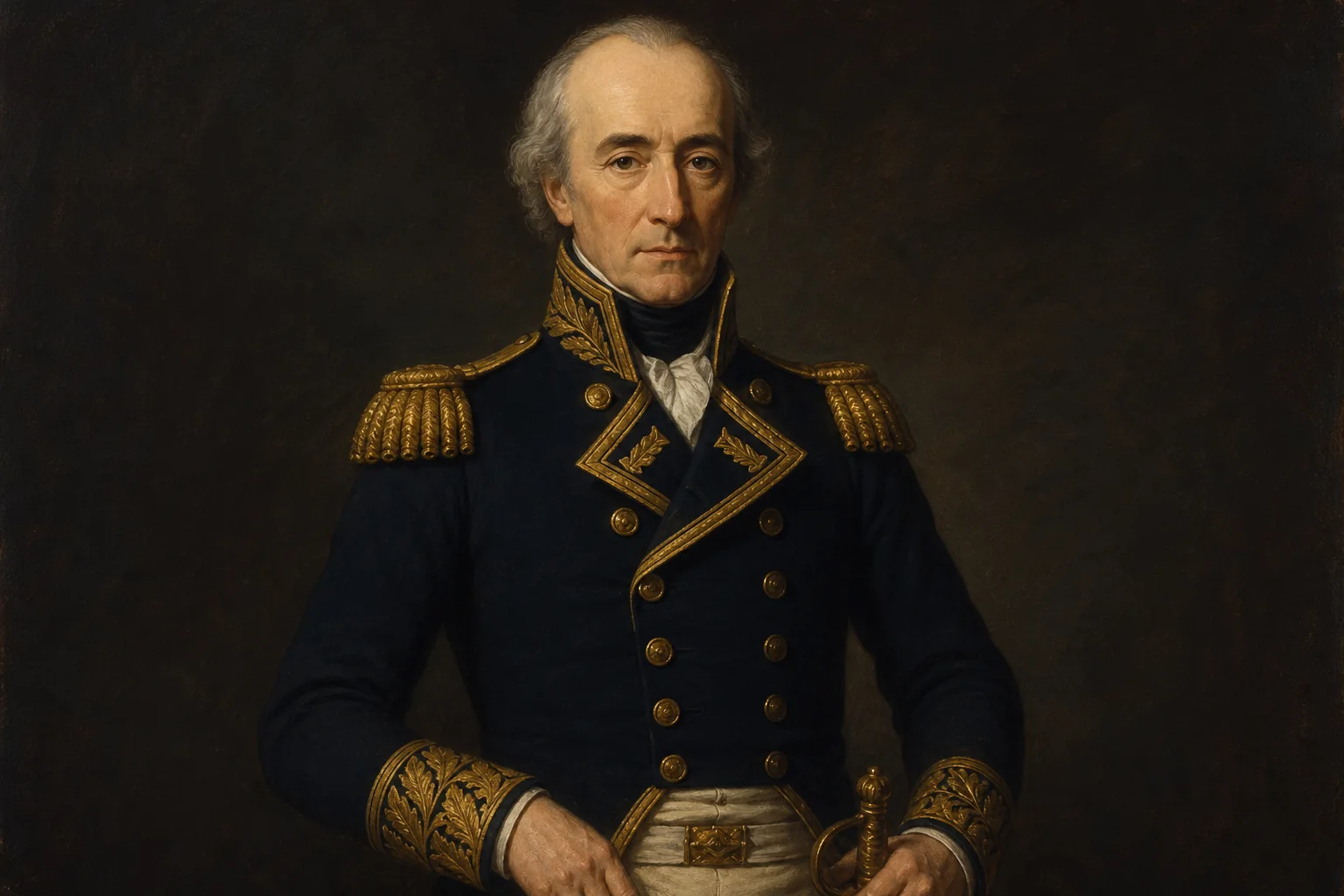 Generated portrait. Not a historical photograph.
Overview
Cuthbert Collingwood, 1st Baron Collingwood (1748–1810) was Nelson’s oldest professional friend and his second-in-command at the Battle of Trafalgar 1805 — Overview. Aboard HMS Royal Sovereign — Overview he led the lee column that broke the enemy line first; on Nelson’s death he took command. He spent the next four and a half years as Commander-in-Chief Mediterranean — “minister at sea” — and died at sea off Menorca in March 1810, refused permission to come home.
Early Life
Born 26 September 1748 in Newcastle upon Tyne to a merchant family (his father later bankrupt), Collingwood was educated at the Royal Grammar School Newcastle, where he befriended the future Lord Eldon. He entered the Navy aged twelve in 1761 aboard HMS Shannon under his cousin Captain Richard Braithwaite. His great-grandfather George Collingwood was hanged at Liverpool in 1716 for Jacobite involvement in the Fifteen.
Career and Key Roles
Collingwood made his lieutenant after fighting in the naval brigade at the Battle of Bunker Hill in June 1775. He twice succeeded Nelson directly — as commander of HMS Badger in 1779 and as post-captain of HMS Hinchinbrook in 1780 — and became close to him in the West Indies from c. 1777; both were attracted to Mary Moutray at English Harbour, Antigua, in 1784 and exchanged sketches of each other. He reached rear-admiral February 1799 and vice-admiral April 1804.
Key Decisions and Actions
At the Battle of Cape St Vincent 1797 — Overview Collingwood commanded the 74-gun HMS Excellent — 74-gun Third Rate under Jervis. He forced the strikings of Salvador del Mundo (112) and San Ysidro (74), then passed between Nelson’s HMS Captain and her opponents, raking San Nicolás and San José with double-shotted broadsides. Nelson wrote afterwards: “a friend in need is a friend indeed was never more truly verified than by your most noble and gallant conduct yesterday.”
At Battle of Trafalgar 1805 — Overview HMS Royal Sovereign — Overview — newly coppered, outsailing the fleet — broke the line first, just astern of Santa Ana. To Captain Rotheram, Collingwood said: “What would Nelson give to be here?”; on Victory a mile away Nelson said to Hardy, “See how that noble fellow Collingwood carries his ship into action!” Wounded in the leg by a splinter, Collingwood took command on Nelson’s death and shifted his flag to HMS Euryalus. His decision after the battle to make for Gibraltar rather than anchor — Nelson’s last quarterdeck order — has been argued ever since: only four of seventeen captured ships of the line reached Gibraltar in British hands.1
Personal Life
Collingwood married Sarah Blackett, daughter of a three-times mayor of Newcastle, in June 1791; they had two daughters and no sons. He carried acorns in his coat pocket on shore walks, pressing them into soil “whenever he saw a good place for an oak tree to grow.” He preferred grog-watering and stern looks to flogging; the seaman Robert Hay said “a look of displeasure from him was as bad as a dozen at the gangway from another man.”
Legacy
Created Baron Collingwood of Caldburne and Hethpool on 9 November 1805 (peerage extinct at his death), he held Mediterranean command from April 1806 — blockading Toulon, Cartagena, and Cadiz, and conducting personal diplomacy with the Sublime Porte. Government refused his repeated requests to be relieved on health grounds. He died of stomach cancer aboard HMS Ville de Paris off Port Mahon on 7 March 1810, within hours of putting to sea, and was buried in the crypt of St Paul’s Cathedral beside Nelson — in a coffin originally prepared for Cardinal Wolsey.
Sources
Related
Navigation
Same Subject — Nelson’s Circle
- Nelson Horatio — Biography Overview
- Hardy Thomas Masterman — Captain HMS Victory
- Jervis John Earl St Vincent — Biography
- Band of Brothers — Nelson’s Captains
Key Battles
Key Ships
- HMS Royal Sovereign — Overview — flagship through his Mediterranean and Trafalgar commands
- HMS Excellent — 74-gun Third Rate
- HMS Victory — Overview
- HMS Ville de Paris — Collingwood Death Ship — death ship only; no rate
Cross-Domain
- Royal Navy — Institutional Overview
- Mediterranean Fleet 1805–10
- Age of Sail — Era Overview
- Mary Moutray — English Harbour 1784 — attraction and sketches, 1784 only
- Collingwood Merchant Family — Later Bankrupt — those two phrases only
- Collingwood Discipline — Grog-Watering — discipline habit only
- Collingwood Splinter Wound — Trafalgar 21 October 1805 — Trafalgar wound only
- Excellent Double-Shotted Rake — 14 February 1797 — rake only
Footnotes
-
The post-Trafalgar anchor decision is the central historiographical controversy of Collingwood’s career. Defenders point to ships too dismasted to anchor and the danger of a building gale on a lee shore; critics note the lost prize money and Nelson’s explicit final order. Hughes (1957) and Adams (2005) lean to Collingwood’s defence; the argument has been re-run at frequent intervals since 1805. ↩