Q — Was it Kiss me Hardy or Kismet Hardy
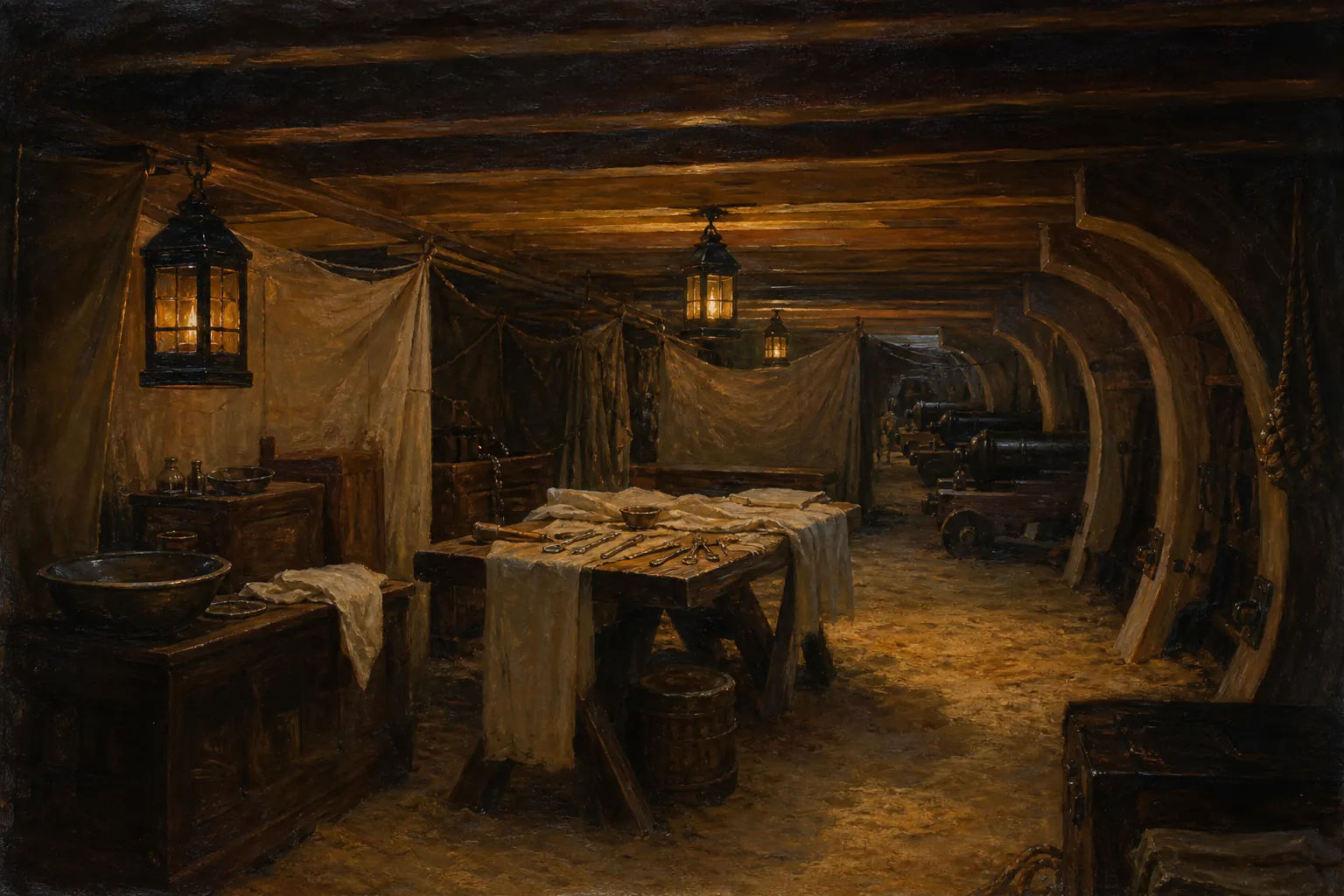 Generated illustration. Not a historical photograph. An orlop cockpit prepared as a surgery. No people. Not a portrait.
Overview
The wording is already rejected on Hardy Thomas Masterman — Captain HMS Victory. The Victorian “Kismet, Hardy” alternative is unsupported: the word kismet is not attested in English before c. 1830, twenty-five years after Trafalgar.1
The Wording
This note covers that wording only. The cockpit hours stay on Battle of Trafalgar 1805 — Death of Nelson.
Beatty Authentic Narrative — 1807 records the kiss on the cheek and then the forehead. The last short words Beatty gives are addressed to Burke and Scott, not to Hardy. Verbatim lines live on @beatty1807nelson. Beatty William — Surgeon HMS Victory remains a red-link.2
Sources
- @beatty1807nelson — pp. 48–52
- @white2005nelson
- @adkin2005trafalgar
- Hardy Thomas Masterman — Captain HMS Victory
- Battle of Trafalgar 1805 — Death of Nelson
- Beatty Authentic Narrative — 1807
Related
Navigation
Same Subject
- Hardy Thomas Masterman — Captain HMS Victory
- Battle of Trafalgar 1805 — Death of Nelson
- Beatty Authentic Narrative — 1807
- HMS Victory — Overview
- Hamilton Emma — Biography
Cross-Domain
- Q — Did Nelson really say “blind eye” at Copenhagen
- Age of Sail — Era Overview
- Age of Sail — Chronological Timeline
Footnotes
-
Victorian “Kismet, Hardy” unsupported; kismet not attested in English before c. 1830, twenty-five years after Trafalgar: Hardy Thomas Masterman — Captain HMS Victory, footnote 1. Do not invent further etymology. ↩
-
Kiss on cheek then forehead; last short words to Burke and Scott: Battle of Trafalgar 1805 — Death of Nelson and @beatty1807nelson. Quotes stay on the Beatty card. Do not invent a Beatty biography. ↩