Chatham to the Tower — Swin Channel Pilotage
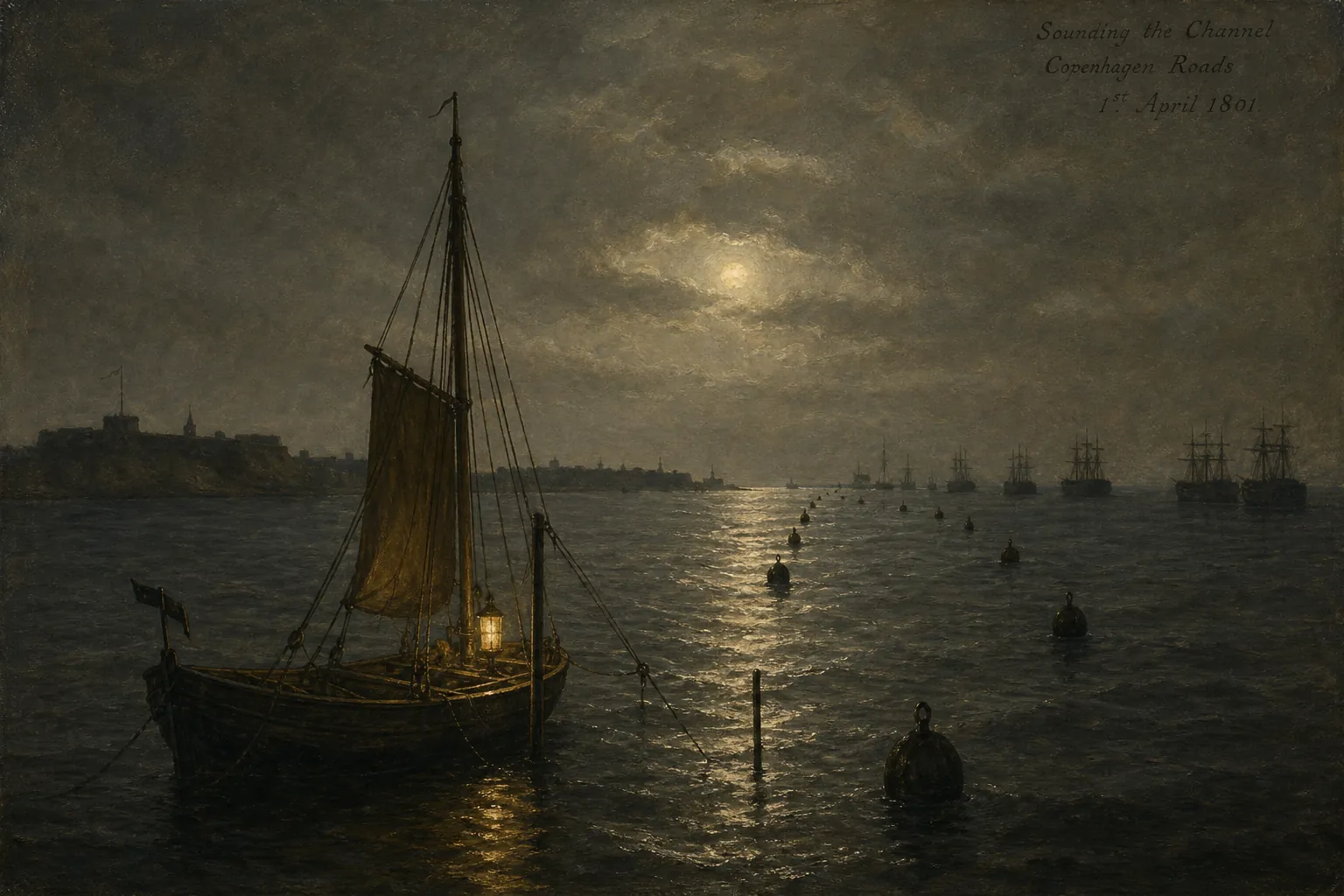 Generated illustration. Not a historical photograph. Soundings work. Not the Swin in 1771, and not a portrait.
Overview
HMS Triumph — Guard-Ship after Falklands already records the Thames guard-ship. Rathbone Merchant Voyage — West Indies already records the merchant voyage. This note covers the cutter-and-long-boat reward and the two pilotage legs only.1
The Pilotage
Southey says that on Nelson’s return his uncle received him on board the Triumph and, discovering his dislike to the navy, held it out as a reward that if he attended well to his navigation he should go in the cutter and decked long-boat attached to the commanding officer’s ship at Chatham. Thus he became a good pilot for vessels of that description from Chatham to the Tower, and down the Swin Channel to the North Foreland, and acquired a confidence among rocks and sands of which he often felt the value.2
The guard-ship posting stays on HMS Triumph — Guard-Ship after Falklands. This page does not invent a year beyond Southey’s 1771 running-head, or name the cutter.
Sources
Related
Navigation
Same Subject
- HMS Triumph — Guard-Ship after Falklands
- Rathbone Merchant Voyage — West Indies
- Chatham Dockyard
- Suckling Maurice — Captain
Cross-Domain
Footnotes
-
Thames guard-ship only: HMS Triumph — Guard-Ship after Falklands. Merchant voyage only: Rathbone Merchant Voyage — West Indies. ↩
-
“Thus he became a good pilot for vessels of that description from Chatham to the Tower, and down the Swin Channel to the North Foreland, and acquired a confidence among rocks and sands of which he often felt the value.” @southey1813nelson vol. 1, p. 10 (1813). Do not invent the cutter’s name. ↩