Climate Weather Index
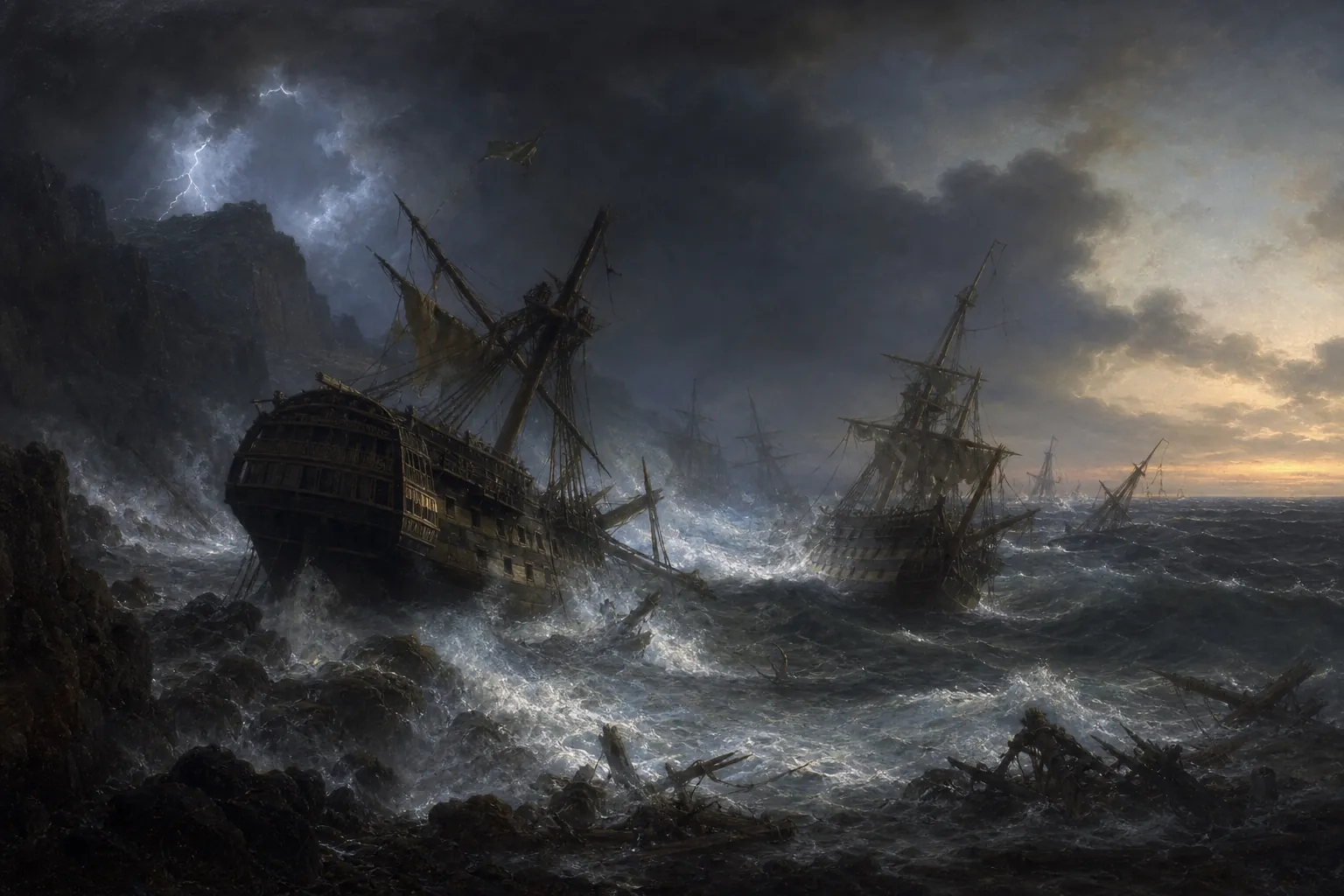 Generated illustration. Not a historical photograph. Prizes on a lee shore.
Hub
Climate and weather have constrained military and political action across every era of recorded history, not just the age of sail. The subdomain examines how prevailing winds, seasonal storms, ocean currents, El Niño cycles, monsoon patterns, drought-flood oscillations, and disease climates have shaped where armies and fleets could operate, when campaigns could be fought, where empires could establish their frontiers, and where commerce and migration could flow. The Bronze Age collapse coincides with regional aridification; medieval European agriculture rose and fell with the Medieval Warm Period and Little Ice Age; the trade-wind logic of Atlantic empire-building set the rhythm of three centuries of European-American interaction; the seasonality of Indian Ocean monsoons structured premodern Eurasian commerce; modern anthropogenic climate change is reshaping security calculations now. The Georgian-era naval dimensions visible in the current vault focus (Caribbean trade-wind strategy, the 1780 Great Hurricane, Mediterranean blockade rotations) are one chapter; the subdomain organises climatological constraint as a research domain across all eras. Adjacent to MOC_Geography_Places, MOC_Food_Provisioning (climate-driven famine and harvest), MOC_Economics_Commerce (climate-driven trade routes), and MOC_Era_Context.
Primary Notes
- Storm After Trafalgar — 24–29 October 1805 — first filled weather note; lee-shore gale after 21 October 1805
- Finisterre Fog — 22 July 1805 — fog delay only; overflow
- Calvi Lion Sun — Half Sick — lion sun / 2000 half sick only; overflow
- Cape St Vincent Squalls — 14 February 1797 — squalls only; overflow
Roadmap
(planned notes as red-links — add as research identifies gaps)
Methodology and frameworks
- Historical Climatology — Methods, Sources, and Reconstructive Techniques
- Climate as Historical Cause — From Le Roy Ladurie to Geoffrey Parker
Ancient and Classical
- The Bronze Age Collapse and Eastern Mediterranean Aridification c. 1200 BC
- Roman Climate Optimum and Late Antique Little Ice Age
- Monsoon Patterns and Indian Ocean Trade in Antiquity
Medieval
- The Medieval Warm Period — Population Growth, Northward Expansion, and Viking Greenland
- The Little Ice Age — Onset, Effects, and the Late Medieval Crisis
- The Mongol-Era Climate — Pluvial Period and Steppe Conquest Capacity
Early Modern
- Atlantic Trade Winds and the Emergence of the Triangular Trade
- Spanish Treasure Fleet Routing — Currents, Hurricanes, and the Carrera de Indias
- Maunder Minimum and the Seventeenth-Century Crisis
Age of Sail (current vault focus)
- Atlantic Trade Winds — Fleet Routing and Seasonal Strategy
- The Great Hurricane of 1780 — Catastrophe in the Caribbean
- Mediterranean Winds — Levante, Tramontane, and Blockade Planning
- Gales of the Bay of Biscay — Losses on the Western Approaches
- Yellow Fever Seasons — Climate and Mortality in the West Indies
Modern (1815–present)
- Nineteenth-Century Industrial-Era Climate — Steam, Coaling, and the End of Wind Constraint
- The 1815 Tambora Eruption and the Year Without a Summer
- La Niña as Strategic Variable
- Anthropogenic Climate Change — Security Implications and Strategic Reframing
Cross-Cutting
- See also: MOC_Geography_Places
- See also: _Home