Campaigns Wars Index
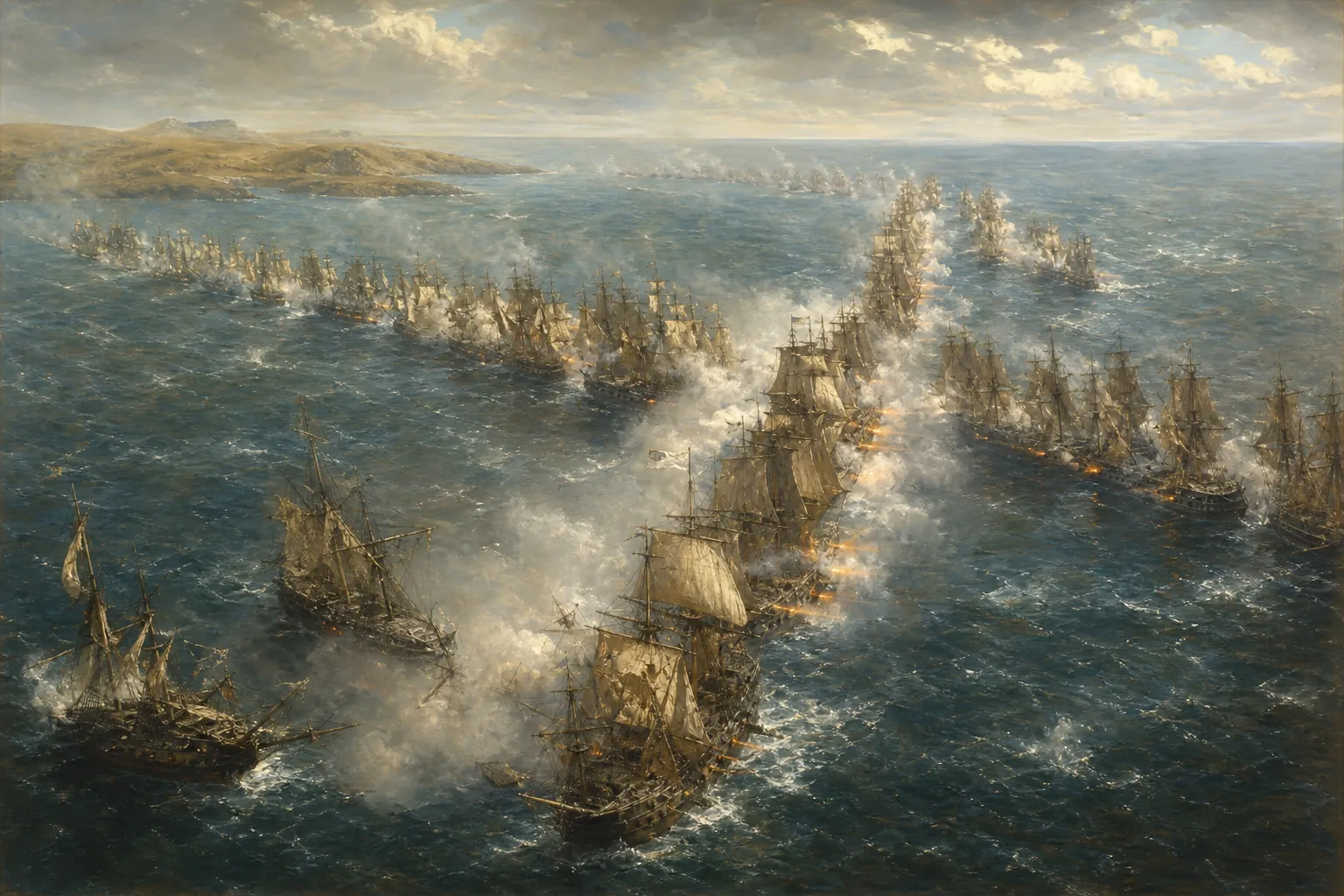 Generated illustration. Not a historical photograph. The 1805 campaign’s decisive battle.
Hub
Campaigns and wars — the multi-battle, multi-season, multi-theatre operational and strategic units within which individual engagements acquire meaning — are the natural object of strategic history. The subdomain covers campaigns and wars as a research domain across every era and civilisation: the ancient Mesopotamian and Egyptian inter-state wars; the Greek wars of Marathon, Salamis, and the Peloponnesian struggle; Alexander’s eastern conquest and the Diadochi wars; the Punic Wars between Rome and Carthage; Caesar’s Gallic and Civil Wars and the long Roman frontier campaigns; the Han-Xiongnu wars and the Three Kingdoms; the Byzantine-Sasanian and Arab-Byzantine conflicts; the Crusades and the Mongol conquests; the Hundred Years’ War and the Italian Wars; the wars of the Reformation and the Thirty Years’ War; the Anglo-Dutch wars and Louis XIV’s War of the Spanish Succession; the global Seven Years’ War and the wars of American independence; the Revolutionary and Napoleonic Wars; the wars of nineteenth-century unification (American Civil War, Italian and German unifications, the Crimean War); the First and Second World Wars; the Korean and Vietnam wars; the Cold-War proxy conflicts; and the post-1989 wars in the Balkans, the Middle East, and Ukraine. Notes examine strategic objectives, coalition dynamics, theatre interaction, mobilisation and economic sustainment, and the way campaigns are remembered. The Revolutionary and Napoleonic Wars and their Mediterranean, Continental, and Atlantic theatres that the current vault focus visits are one chapter of this much longer history. Adjacent to MOC_Conflicts, MOC_States_Empires, MOC_Military_Forces, and MOC_Era_Context.
Primary Notes
- Trafalgar Campaign 1805 — Atlantic feint, Calder’s Action, Cadiz blockade, 21 October 1805
- Egyptian Expedition 1798–1801 — Toulon to Egypt; Nile; army stranded
- Marseillois — de Grasse American War Fleet — Villeneuve ensign only; no year; no rate
- Carcass Coxswain — Phipps Arctic Voyage 1773 — coxswain posting only; overflow
Roadmap
(planned notes as red-links — add as research identifies gaps)
Methodology
- Strategic History as a Method — From Clausewitz to RAND
- Operational Art — The Level Between Battle and Strategy
- War-Termination Studies — Why Wars End When They End
Ancient
- The Greco-Persian Wars — Marathon, Thermopylae, Salamis, Plataea
- The Peloponnesian War — Athens vs Sparta and the Strategy of Attrition
- The Conquests of Alexander the Great
- The Punic Wars — Three Conflicts that Built Roman Mediterranean Hegemony
- The Han–Xiongnu Wars and the Steppe Frontier
- The Roman-Sasanian Wars 224–628
Medieval
- The Arab Conquests of the Seventh and Eighth Centuries
- The Crusades — Eight Major Campaigns and Their Strategic Failure
- The Mongol Conquests — Genghis Khan to Kublai Khan
- The Hundred Years’ War — England vs France 1337–1453
- The Reconquista — Eight Centuries of Iberian Frontier War
Early Modern
- The Italian Wars 1494–1559
- The Wars of the Reformation and the Thirty Years’ War
- The Anglo-Dutch Wars and the Rise of English Sea Power
- The War of the Spanish Succession 1701–1714
- The Seven Years’ War 1756–1763 — The First Global Conflict
- The American Revolutionary War 1775–1783
Age of Sail (current vault focus)
- Trafalgar Campaign 1805 — first filled campaign note
- French Revolutionary Wars 1792–1802 — Strategic Overview
- Napoleonic Wars 1803–1815 — Strategic Overview
- Mediterranean Campaign 1798–1800
- Continental Blockade — Napoleon’s Economic War
- War of 1812 — North American Naval Theatre
- Peninsular War 1808–1814 — Iberian Campaigns
Long Nineteenth Century
- The Crimean War 1853–1856
- The American Civil War 1861–1865
- The Wars of Italian and German Unification
- The Russo-Japanese War 1904–1905
Modern
- The First World War 1914–1918 — Strategic Overview
- The Second World War 1939–1945 — Strategic Overview
- The Korean War 1950–1953
- The Vietnam War 1955–1975
- The Cold War as a Multi-Theatre Strategic Competition
- 11 Counter-Insurgency Wars
- The Russo-Ukrainian War 2022–
Cross-Cutting
- See also: MOC_Conflicts
- See also: _Home